
Insights
How to plan a specialty food restock week on Instagram
One back-in-stock post is an announcement, not a week. Give each day a single job, build the week from what is on the shelf, keep stock claims true, and read every caption yourself before it ships.
Kushal Shrestha
Marketing & Engineering
7 min read
In short
- A restock week needs five posts with five jobs: announce, prove, cook, trust, shop.
- Start from what is true in the warehouse: units on hand, SKU facts, photos you already have, the offer.
- Name the product noun in the first line of every caption and give each day one job.
- Say what is limited (this lot, this window) and update the shop caption if stock changes.
- Read each caption next to its photo and approve it before anything is scheduled.
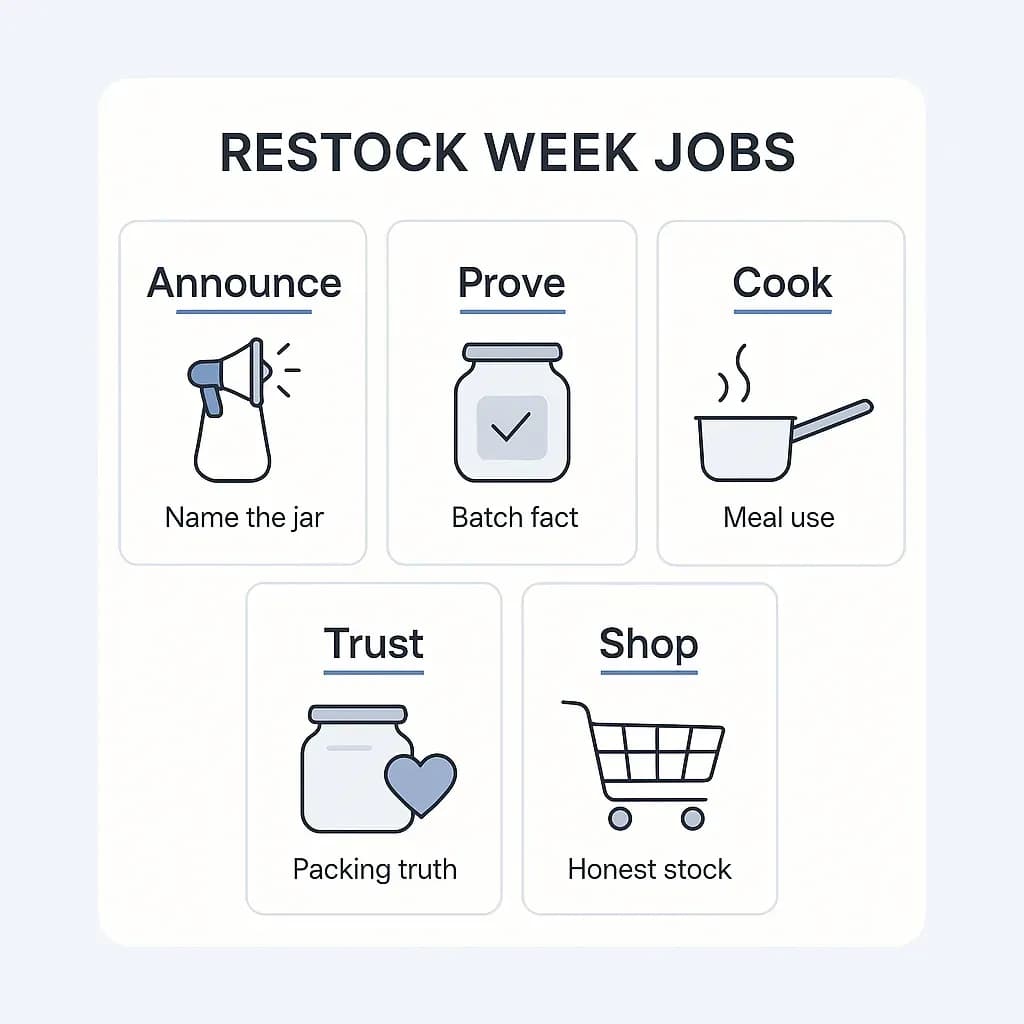
A specialty food restock works best as one week of five posts, each with a single job: announce, prove, cook, trust and shop. Build the week from what is true in the warehouse, keep any "limited" claim honest, and read each caption next to its photo before it ships. This is for owner-run food brands that sell jars, bags or bottles and handle their own Instagram.
The usual failure is one "Back in stock!" post, a few hearts, then a quiet week. Public launch guides agree that attention peaks around a real moment (Shopify on product launches, Shopify launch checklist). Instagram guides say to plan posts around a goal (Shopify, Buffer, Later, Hootsuite). Use their structure. Do not paste their swipe files onto your drop.
A restock is a sequence, not one post
One "back in stock" line is an announcement. A week lets people see the jar, believe the batch, picture dinner, trust the maker, then buy while the stock claim is true.
| Day job | What the post must do | What fails |
|---|---|---|
| Announce | Name the product and say that it ships | Excited energy with no jar fact |
| Prove | One batch, process or label fact | "Crafted with love" filler |
| Cook | One concrete use (Tuesday tacos, Sunday eggs) | Vague "elevate your meals" |
| Trust | Real packing, a batch note, an allergen note | Invented testimonials |
| Shop | Honest stock and a clear link | Scarcity when the shelf is full |
Lock these jobs before you open a caption tool:
- Announce: product name, size, and "back" or "limited drop" only if true today.
- Prove: one process fact, such as smoke time, pepper cut, jar date or lot size.
- Cook: one meal or use a regular already knows.
- Trust: a packing line, an allergen note or a batch card, not lifestyle fluff.
- Shop: price band or pack size, plus stock you can fulfil.
An optional sixth is a Stories reply day. Keep it to one job per frame.
Build the week from inventory
Do not start with "content ideas". Start with the facts you can stand behind.
| Input | Ask | Output |
|---|---|---|
| Units on hand | How many can ship this week? | A cap for any "low stock" claim |
| Product facts | Heat level, size, ingredients, jar date | Lines for announce and prove |
| Photo set | Label hero, pour, packing, plated | One real frame per job |
| Offer | Restock only, bundle or local pickup | Wording for the shop post |
Then assign one job per day, or every other day if daily posting is not realistic. A skipped day beats a filler day.
Caption seeds to fill in and say out loud (all from the hypothetical sauce below):
- "Ridgefire is back. 5 oz. Ships today."
- "Same habanero mash. Same 48-hour rest."
- "Tuesday tacos. One spoon on the meat, not the tortilla."
- "Ladled, sealed, labeled. Then it leaves."
- "Two sizes. Stock is real. Link in bio."
Cut these from a restock week:
- "Excited to restock our thoughtfully crafted..."
- "Limited" when you just filled twenty cases
- Essay captions nobody would text a regular
- A lifestyle montage with no jar in it
- The same announcement posted five times
Worked example (hypothetical hot sauce)
Hypothetical, not a customer story: you sell "Ridgefire Habanero", a 5 oz small-batch hot sauce. You just bottled 180 jars. Photos on hand: label hero, mash pot, packing table, taco plate. A generic first draft might read:
Day 1: Thrilled to announce our limited restock! Day 2: Elevate your culinary journey with Ridgefire. Day 3: Our community means everything. Day 4: Transform dinner tonight. Day 5: Shop now before it's gone!!!
This draft could sell anyone's sauce. It never names a use, and it hints at urgency without saying how many jars exist. Here is the same week with one job per day:
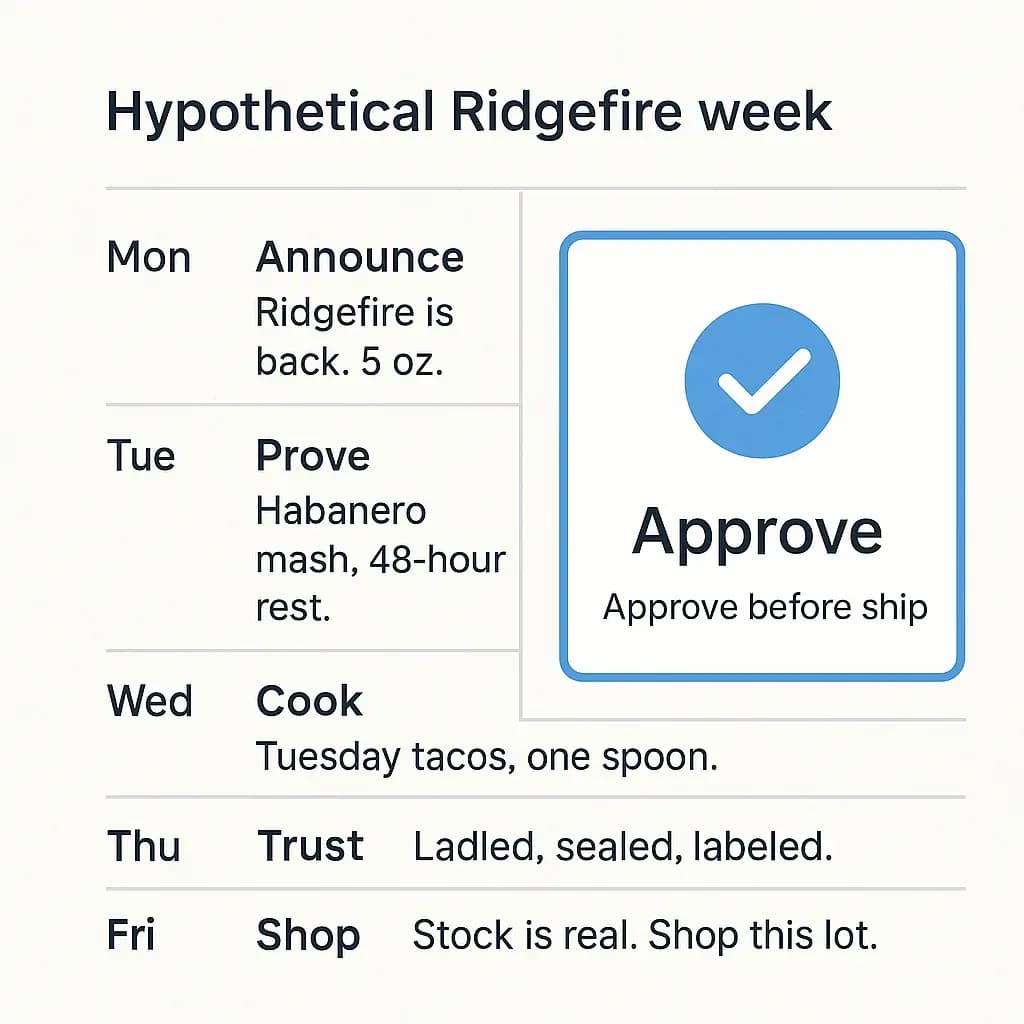
| Day | Job | Caption seed | Photo |
|---|---|---|---|
| Mon | Announce | Ridgefire Habanero is back. 5 oz. Ships today. | Label hero |
| Tue | Prove | Habanero mash, 48-hour rest, then bottle. Same recipe as last lot. | Mash pot |
| Wed | Cook | Tuesday tacos: one spoon on the meat. | Taco plate |
| Thu | Trust | Ladled, sealed, labeled on the packing table. Then it leaves. | Packing table |
| Fri | Shop | 5 oz and 8 oz. Stock is real. Shop while this lot lasts. | Both sizes |
Check each line before it goes in the plan:
| Check | Pass when |
|---|---|
| Specific noun in the first line | Jar, mash, spoon or table is named |
| One true stock story | The 180 jars become "this lot", not a fake flash sale |
| Voice test | You would text this line to a regular |
| One job per day | Yes |
Coffee, jam and pasta sauce follow the same grid. Swap the noun (bag, jar, lid) and the cook line (pour-over, toast, Tuesday pasta). Do not borrow a skincare-style ritual speech for food. For a skincare version of the same idea, see the week-of-posts plan for a skincare brand.
Scarcity rules that keep trust
A restock or limited drop only works if the claim matches the shelf.
- Say what is limited: this lot, this pepper run, this preorder window.
- Prefer numbers you can defend ("about 180 jars this lot") over empty fireworks.
- If stock recovers mid-week, update the shop caption. Do not leave a stale claim live.
- Never copy scarcity wording from a swipe file when the warehouse is full.
Keep food claims to what is on the label and in the batch record. The trust post is the place for an allergen note or a packing detail, not for health promises.
Approve before anything ships
Method first, tool second.
- Pull inventory, product facts and photos.
- Assign announce, prove, cook, trust and shop.
- Draft the captions. AI is fine for a first pass.
- Read each caption next to its photo: does it pass the voice test and name the jar?
- Approve, then schedule. Do not skip the approval.
If you want drafts built from your own website voice, Youanai Social creates a Business DNA profile and drafts posts that wait for your approval before anything is posted. The same logic is covered in approve-to-ship for one-person ecommerce brands. For wording that does not sound like every other jar, see captions that don't sound like generic AI. If the whole month is blank, start with filling an empty ecommerce calendar. If photos are the constraint, turning product photos into an Instagram week covers it.
FAQ
How many Instagram posts should a food restock get?
Five posts across a week is enough for most one-person specialty brands. Fewer is fine if you cannot shoot five frames. Skip a day rather than invent filler.
What is the difference between a restock and a limited drop?
A restock returns a known product. A limited drop is a finite lot or window. Both need honest stock language, and a normal restock should not be labelled "limited" for engagement.
Can AI write my restock captions?
For a first draft, yes. For the final caption, read and approve it yourself rather than autoposting. Keep the jar noun, one fact and one job. Caption idea banks such as Shopify's captions guide are a starting point, not your voice.
Should I reuse the same restock week every time?
Reuse the jobs, not the sentences. Swap the lot fact, the cook line and the photo. Three sauces with identical weeks and a find-and-replace noun will read as copies.
What if I only have one good product photo?
Run announce and shop on that hero, then shoot one process frame and one plated frame before the next restock. A thin week of true posts beats a thick week of stock photos that are not yours.
What should I say about allergens in a restock post?
Put the allergen note in the trust post, taken from your label, and keep it as plain as the label. Do not add claims beyond what the label and your batch records support, and check local labelling rules if unsure.
Keep reading
Instagram Comment Ideas for Small Product Brands

Reply examples for the comments a small product brand actually gets, from ingredient questions to public complaints, plus honest ways to invite…

10 min read
Cottage Food Law Illinois: Selling and Promoting Online
Illinois allows in-state online sales and shipping of cottage food, with registration, a CFPM and a set label. Here is what the…
10 min read
Ecommerce Product Photography at Home: A Simple Setup

A phone, a window, a plain surface and a fixed shot list are enough to photograph a small catalogue consistently. Here is…

11 min read