
Insights
Empty calendar for a one-person ecommerce brand
Your calendar stays empty because shipping and stock win the week. Fill one week from one SKU with Product, Proof, Process, Offer. Approve before you post.
Youanai Editorial
4 min read

Your calendar is not empty because you lack creativity. It is empty because packing orders, answering DMs, and restocking beat “make content” every week.
If you run a small Shopify-ish shop alone, agency pillar templates feel like homework. A fake 30-day dump ignores shipping weeks. You need a floor you can keep: one live SKU, three posts, one week. Then you approve before anything goes live.
This is not a remake of our weekly plan for one skincare product. That piece is a worked beauty example. Here the job is the blank week itself: how a solo ecommerce operator fills a calendar without a VA or an agency suite.
Why your calendar stays empty
Name the real constraints:
- Stock and ship days wipe the afternoon you meant for Reels
- Product photos exist, but captions stall
- Customer questions live in DMs and never become posts
- Agency calendars assume a content person you do not have
- Last week’s “I’ll batch on Sunday” plan died in packing
Creativity is rarely the bottleneck. Capacity is. Public cadence guides aimed at small businesses often land around three to five feed posts per week as a sustainable range for owner-operators (Poppify, 2026; GFX Saga on ecommerce calendars). Treat those as operator floors, not hustle maxes. If three solid posts beat seven half-finished ones you abandon by Wednesday, keep three.
Four pillars you can actually refill
Skip lifestyle influencer pillars. Tie every slot to inventory and the product page.
| Pillar | Fill rule (one line) |
|---|---|
| Product | Show the SKU you can ship this week, with one fact from the page |
| Proof | Use a review line, restock note, or UGC you already have permission to show |
| Process | Packing, pouring, labeling, sourcing. Real work, not vibe B-roll |
| Offer | Only if true today: restock, bundle, or honest availability |
Worksheet:
- Live SKU this week: _______________
- Product post angle: _______________
- Proof source (review / restock / photo): _______________
- Process moment you can film in under 10 minutes: _______________
- Offer (or “none this week”): _______________
If you cannot fill those five lines from your store admin and your camera roll, stop. Do not open a tool that invents sludge.
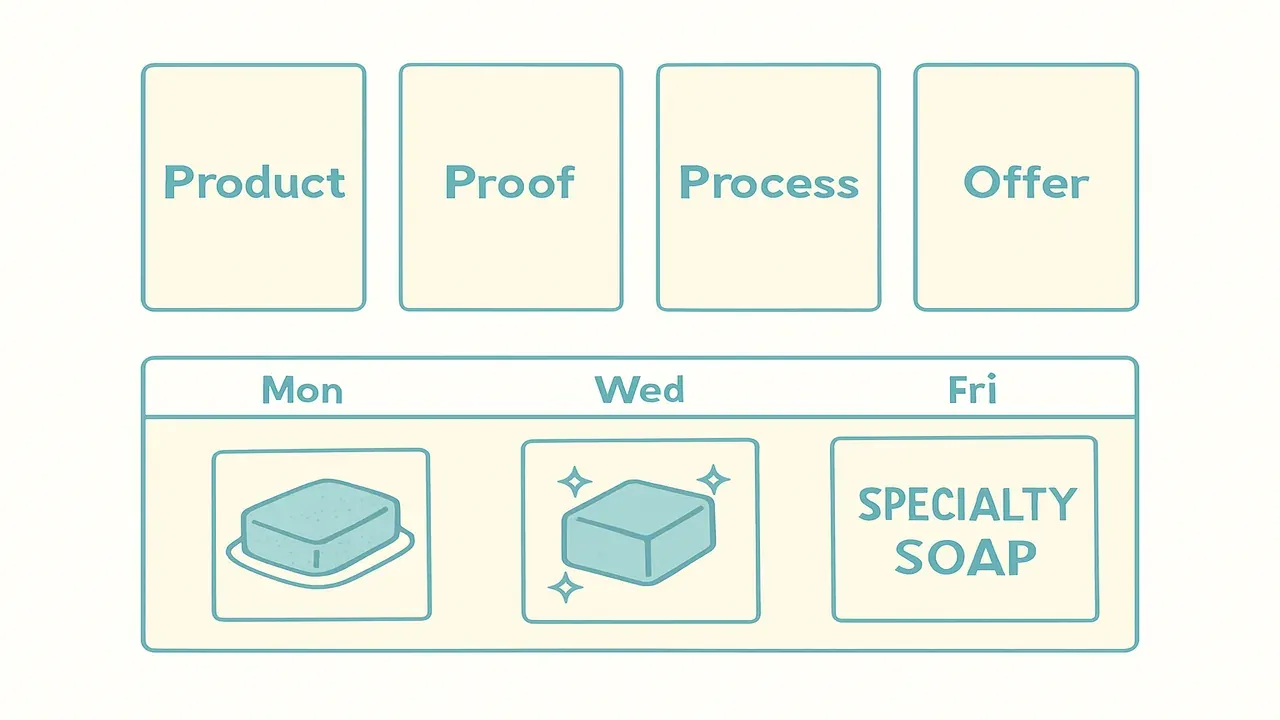
One SKU, three posts, one week
Minimum viable week for a solo operator:
| Day | Pillar | Job |
|---|---|---|
| Mon | Product | One clear product fact + one usable photo |
| Wed | Proof or Process | Evidence or packing/process |
| Fri | Offer or Product again | Restock/availability if true; otherwise a second product angle |
That is three feed posts. Stories are optional extras, not the quota. Cross-post the same root idea with light edits if you run two channels. Do not invent six unique pieces because a template said so.
Hypothetical (not a customer story): you run a small specialty soap brand. Live SKU: “Cedar & Clay Bar, 4 oz.” You have five product photos, one packing shot, and two review screenshots you can quote. Shipping runs Tue/Thu. Your week:
- Mon Product: bar on kraft paper; caption names scent and who it is for
- Wed Process: pouring molds / cutting bars / labeled boxes
- Fri Proof: short review quote + “back in stock for this week”
Jewelry works the same way. One pendant, three angles: materials shot, bench process, buyer proof. Keep the SKU constant so the week stays shippable.
For a beauty vertical deep dive with shot lists and caption shape, use the skincare weekly plan. Borrow the discipline. Do not copy the cream.
What not to schedule when you’re alone
Kill these when you are the only marketer:
- Daily Reels quotas you cannot shoot after packing
- “30 days of content” dumps that ignore out-of-stock weeks
- Lifestyle filler that could swap any brand name
- Fake urgency (“selling out tonight”) when stock is fine
- Agency client-suite language (“pillars for stakeholders,” “deliverables for the brand”)
- Autopost without reading the caption
Consistency beats spikes. Three posts every week for a month beats twenty posts one week and silence the next. Public founder-facing cadence notes make the same point: start where quality holds, then raise only if capacity is real (Monolit on Instagram cadence for founders, 2026).
From blank week to reviewable drafts
Method first. Tool second.
- Pick one live SKU and fill the four-pillar worksheet
- Choose three slots for the week (Product / Proof-or-Process / Offer-or-Product)
- Draft captions from page facts, not from “sound premium” prompts
- Attach real photos you own
- Review as if a stranger will screenshot it
- Approve, then schedule. Do not skip the approve step
Owner-run shops that need a calendar filled without sounding like AI sludge fit the ecommerce brands lane we build for. If you want drafts waiting for your yes instead of a blank week staring at you, start from an empty calendar in Youanai Social. AI can draft. You still make the call before anything ships.
FAQ
How many social posts does a one-person ecommerce brand need per week?
Start with three feed posts you can keep. Three to five is a common sustainable range in small-business cadence guides. Raise only when quality and packing still fit the same week. Stories do not replace the three.
What’s a simple content calendar if I only have product photos?
Use Product, Proof, Process, Offer. One SKU. Three posts. Mon product photo + fact, Wed packing or review proof, Fri offer or second product angle. No lifestyle shoot required.
Should I hire an agency when my calendar is empty?
Only if you want client-suite process and can brief them every week. An empty calendar is often a capacity problem, not a strategy gap. Fix the floor first: one SKU, three posts, approve-before-publish. Agency listicles and scheduler “replacements” do not fix shipping weeks.
Can AI fill my calendar without me reading every post?
No. Use AI to draft from your product facts. Read every post. Approve before publish. Autopost without review is how sludge and wrong claims land on your grid.