
Insights
How to Rewrite AI Captions So They Sound Like You
A generic AI caption fits any brand. A short checklist of five constraints and four passes turns it into a line only your shop could write, and an approval step keeps it that way.
Kushal Shrestha
Marketing & Engineering
6 min read
In short
- A caption sounds generic when it still works after you swap in a competitor's name.
- Fix each draft with five constraints: one product fact, one specific noun, a say-it-aloud test, no fake urgency, one job.
- Run four passes on the same draft: fact, noun, cut, job.
- Use a short template: specific noun, one product fact, an optional honest call to action.
- Read the caption next to the real photo and approve it before it is scheduled.
Generic AI captions share one fault: swap in a competitor's brand name and the line still works. The fix is a short checklist of five constraints, then four rewrite passes on the same draft, then your approval. This is for owners of small ecommerce and product brands who write their own captions and have a good photo but flat words.
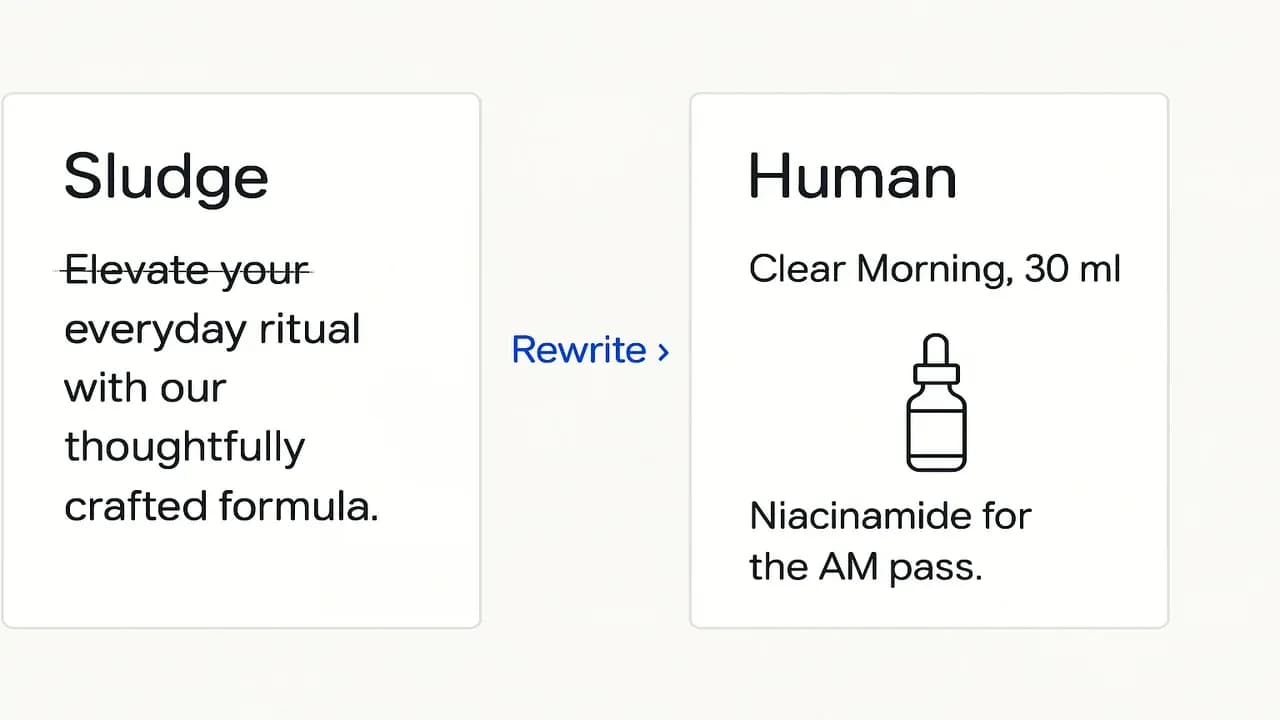
A typical first draft reads like this: "Excited to share our thoughtfully crafted formula designed to elevate your everyday ritual." Nobody talks like that, and it says nothing about the jar in the photo.
Why captions sound generic
AI writing is not the problem. A caption that fails what could be called the stranger test is. If the line fits any brand's product, it fits none.
| What the draft says | Why it fails | Fix |
|---|---|---|
| Excited, thrilled, honored, with no fact | Energy without a product | Open with a noun from the label |
| Ritual, elevate, journey, transformative | Could describe any product | Name the use: morning cleanse, Tuesday pasta, restock |
| Fake scarcity | Stock is fine, and trust drops | Only claim stock you can ship today |
| Paragraph-length captions | Hard to read on a phone | One job, three short lines at most |
| A wall of hashtags | Noise over meaning | Zero to five relevant tags, after the words |
Public caption guides agree on the basics: know the goal, be specific, match the brand (Shopify on Instagram captions, Buffer caption ideas, Hootsuite caption tips, Later caption ideas). Use them as a floor. Do not paste their swipe files onto your grid.
Five constraints to set before you rewrite
Locking these in is faster than asking a model to "sound more human".
- One product fact from the product page: an ingredient, a size, a process, a price band, a restock.
- One specific noun a customer would recognise, such as a serum dropper, a tomato lid or a kiln shelf.
- The say-it-aloud test. If you would not text it to a regular customer, cut it.
- No fake urgency. Mention scarcity only if the stock or the offer is real today.
- One job per caption: announce, explain, make people want it, build trust, or send them to shop. Not all five.
AI can draft. These constraints decide what survives.
Four passes to rewrite a draft
Run these on one draft, in order.
| Pass | Question | Action |
|---|---|---|
| 1. Fact | What is true on the product page? | Keep one claim and delete the rest |
| 2. Noun | What object is in the photo? | Name it in the first line |
| 3. Cut | Would you say this out loud? | Delete ritual, elevate, journey and similar words |
| 4. Job | Announce, explain, desire, trust or shop? | Keep one job and one optional call to action |
The template to fill in: [Specific noun]. [One product fact]. [Optional honest call to action].
Hypothetical seed lines, to show the shape:
- "New jar. Same Tuesday night pasta."
- "Dropper first. Then moisturizer. That's the order."
- "Ladled, sealed, labeled. Then it leaves."
- "Two sizes. Same recipe. Stock is real."
Delete on sight: "Excited to announce" with no product fact, "thoughtfully crafted for the modern anyone", "Elevate your ritual today", long essays you would not say aloud, and scarcity lines when the shelf is full.
Worked example: a hypothetical serum
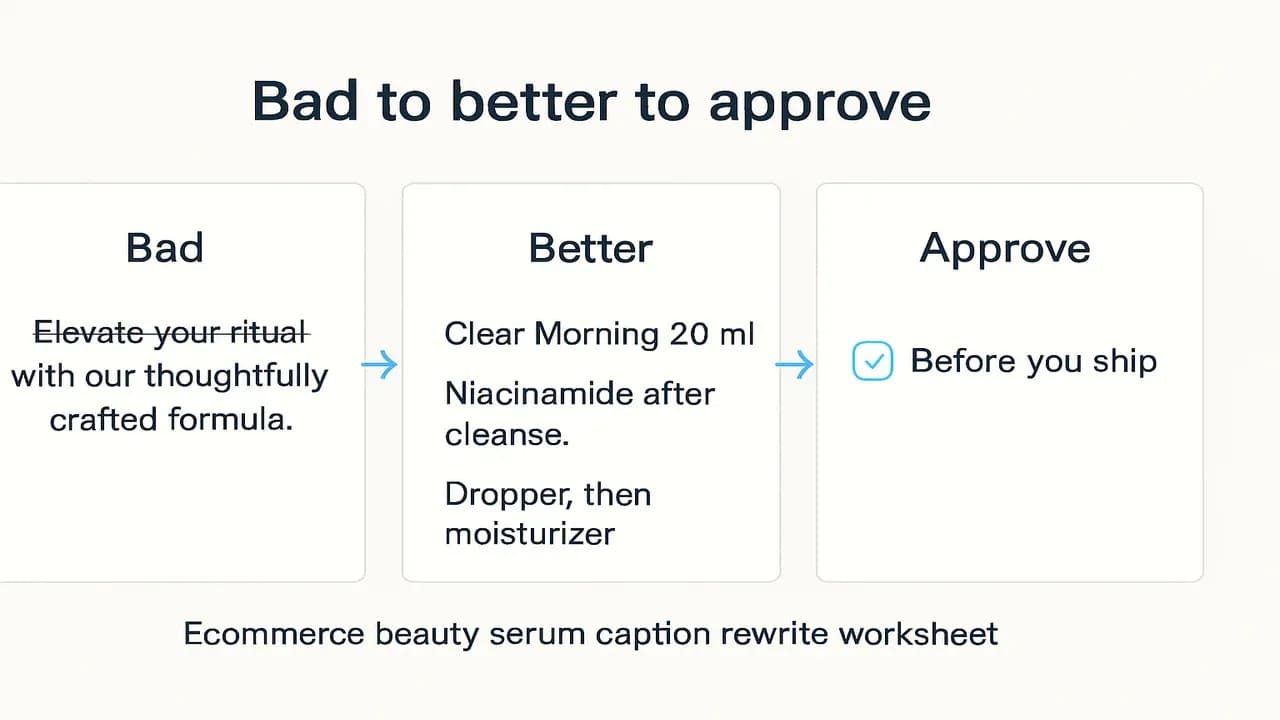
Hypothetical, not a customer story. The brand sells "Clear Morning", a 30 ml niacinamide serum. The photo is a clean bottle on a rice-paper backdrop. The first AI draft:
Excited to share our thoughtfully crafted Clear Morning serum, designed to elevate your skincare ritual and transform your glow journey. Limited stock — shop now!
It fails every constraint: no fact beyond the name, invented urgency, essay tone, and two jobs in one post. After the four passes:
Clear Morning, 30 ml. Niacinamide for the morning pass after cleanse. Dropper, then moisturizer.
| Line | What it passes |
|---|---|
| Clear Morning, 30 ml | Noun and size from the page |
| Niacinamide for the morning pass after cleanse | One fact, one job (explain) |
| Dropper, then moisturizer | Say-it-aloud test; no filler words |
The same method works for specialty food. Announce the jar, explain one lid or ingredient fact, or build trust with a real packing line. Do not invent lifestyle filler to sound premium. Keep claims to what the label and product page already say, and add no health benefits.
Approve before anything ships
The method comes first and the tool second. A workable order:
- Draft from product-page facts. An AI first pass is fine.
- Run the four passes and the five constraints.
- Read the caption next to the real photo.
- Ask whether a regular customer would believe it tomorrow.
- Approve it, then schedule it. Do not skip the approval.
If the problem is a blank week, not the wording, start with how one person fills an empty ecommerce calendar. If photos are ready but post jobs are not, see turning product photos into an Instagram week. Beauty brands can borrow structure from the weekly plan for one skincare product, and the approve-to-ship workflow covers the review step in more detail.
Youanai Social builds a Business DNA profile from your website (brand voice and offer rules), drafts social posts from it, and holds every draft for your approval before anything is posted.
FAQ
How do I make AI captions sound less like AI?
Give the model facts from the product page, force a specific noun, cut words like ritual and elevate, pick one job, then approve. Asking it to "sound more human" without constraints usually produces longer, vaguer text.
Should I use an AI Instagram caption generator?
Yes for a first draft if the page is blank. No for the final caption: read it and approve it yourself. Public idea banks such as Buffer and Shopify are a starting floor, not a finished voice.
How long should an ecommerce Instagram caption be?
Short enough that you would text it. One to three short lines usually beats a paragraph. Add a call to action only when the job is to shop and the claim is true.
Can I reuse one caption template for every product?
Reuse the passes, not the sentence. Swap the noun and the fact each time. Five near-identical captions across five products read as a find-and-replace.
What is the difference between a caption seed and a finished caption?
A seed is a one-line job fill, such as "New jar. Same Tuesday night pasta." A finished caption has passed the say-it-aloud test and the constraints, and has been approved next to the photo.
Where do I get ideas for what to post, not just how to word it?
Start from what you sell: ingredients, sizes, process, restocks and customer questions. The post AI social media post ideas from what you sell shows how to turn those into post jobs.
Keep reading
Instagram Comment Ideas for Small Product Brands

Reply examples for the comments a small product brand actually gets, from ingredient questions to public complaints, plus honest ways to invite…

10 min read
Cottage Food Law Illinois: Selling and Promoting Online
Illinois allows in-state online sales and shipping of cottage food, with registration, a CFPM and a set label. Here is what the…
10 min read
Ecommerce Product Photography at Home: A Simple Setup

A phone, a window, a plain surface and a fixed shot list are enough to photograph a small catalogue consistently. Here is…

11 min read