
Insights
Cottage Food Law Illinois: Selling and Promoting Online
Illinois allows in-state online sales and shipping of cottage food, with registration, a CFPM and a set label. Here is what the IDPH material says and how to promote it with cautious wording.
Kushal Shrestha
10 min read
In short
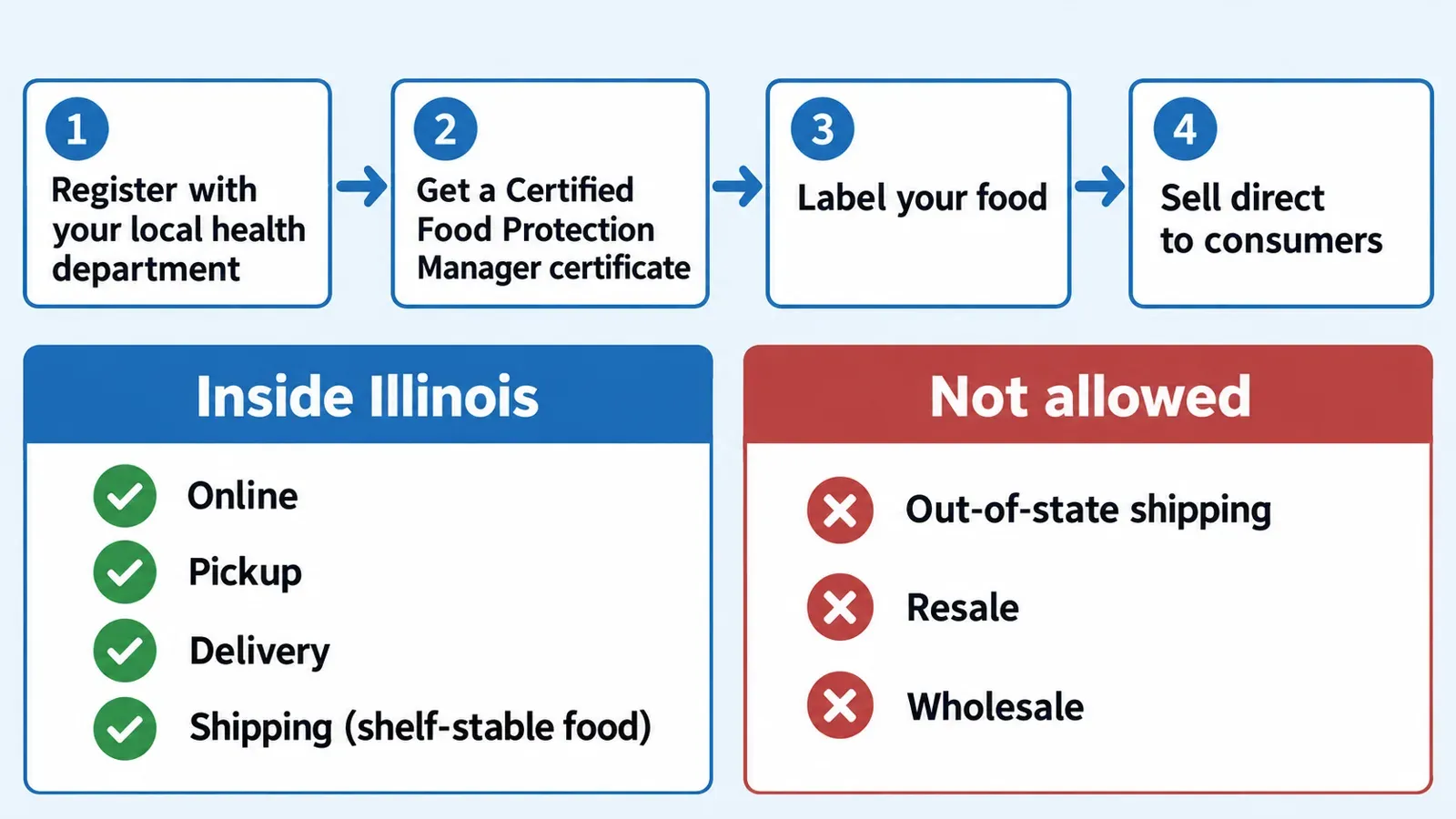
- Illinois cottage food operators register with their local health department, hold a Certified Food Protection Manager certificate, and pay a fee of $0 to $50.
- Online sales and shipping are allowed inside Illinois only, direct to consumers. No out-of-state shipping, no resale, no sales cap.
- Labels need a fixed set of items, including a home-kitchen notice. The online point of sale needs its own notice.
- Suggestions, not rules: On Instagram and a shop page: say 'Illinois delivery only', show the label, repeat the notice on each product page, and use factual descriptors only.
- This is a summary of official guidance, not legal advice. The statute text could not be opened, and the main guide dates from 2024.
Illinois allows homemade food to be sold online, but only inside the state and only direct to consumers. You register with your local health department, hold a Certified Food Protection Manager (CFPM) certificate, use a set label and pay a registration fee between $0 and $50. This guide is for a small Illinois food maker who wants to sell and promote what comes out of a home kitchen. It covers what the official Illinois Department of Public Health (IDPH) material says, then how to talk about the food on Instagram and a shop page within those rules.
Two limits first. The statute text (410 ILCS 625/4) could not be opened while researching this article, so the rules below come from IDPH pages and the IDPH-authored 2024 Cottage Food Guide. A 2024 guide may be out of date. This is not legal advice: confirm every point with your local health department before you sell or post.
What the IDPH says you must do before selling
Illinois cottage food starts with registration. The IDPH cottage food page says to register with the local health department where you live. The 2024 Cottage Food Guide (pp. 4 to 5) adds the details:
- Register in your county of residence. After that you may sell in any Illinois county.
- Registration is annual, and it can take up to six weeks, so start before you plan a launch.
- The fee is capped at $50 by law. Each local health department charges between $0 and $50. DuPage County, for example, charges $50.
Training is the second requirement. The same guide (pp. 5 to 6) says a Certified Food Protection Manager certification is required for the operator and for anyone who prepares or packages the food. A basic food handler card is not valid for this.
Local rules still exist. The guide (pp. 18 to 19) says local governments cannot ban cottage food operations or limit them to farmers markets, but local zoning, signage and home-occupation rules still apply. Ask about those when you register.
What you can sell, and what you cannot
The IDPH page says allowed foods are foods and drinks other than those listed as prohibited by Illinois law. Canned, acidified and fermented foods carry extra requirements. The guide (pp. 6 to 7) gives examples of prohibited foods:
- Meat, poultry, fish and shellfish
- Most dairy
- Cheesecakes and cream or custard pies
- Low-acid canned foods
- Kombucha and alcoholic drinks
These are examples, not a full list. If your product is anywhere near this list, ask your health department before you photograph it, let alone sell it.
Where and how you can sell
Since January 1, 2022, cottage food may be sold directly to consumers within Illinois. The guide (p. 14, p. 21) lists farmers markets, delivery, fairs and public events, online sales, pickup, and shipping within the state. Only non-potentially hazardous food may be shipped, and it must be sealed so tampering is visible, such as with a sticker or pop top.
| Question | What the 2024 guide says | Page |
|---|---|---|
| Sales cap? | No | p. 15 |
| Online sales? | Yes, within Illinois | p. 14, p. 21 |
| Ship inside Illinois? | Yes, non-potentially hazardous food, tamper-evident seal | p. 14, p. 21 |
| Ship out of state? | No: "Cottage food laws do not allow products to be shipped out of state." | p. 15 |
| Etsy and similar marketplaces? | Sales must stay within Illinois | p. 15 |
| Wholesale, resale, restaurants, grocery pop-ups? | No, direct to consumer only | p. 15 |
| Craft malls? | Only if the operator or an employee is present for each sale | p. 15 |
The IDPH page also says the food may not be sold for resale or in retail food establishments.
If you are comparing states, the rules differ a lot. Our Wisconsin cottage food guide covers that state on its own terms; do not assume anything carries over.
Markets and events
Some Illinois sales happen at organizer-run events, and they set their own rules on top of the law. Three examples from organizer pages:
- Green City Market in Chicago is invite-only with applications once a year, and prohibits "Hobby ware, art objects, crafts, and clothing". Products must come from IL, IN, MI or WI.
- Renegade Craft is juried with a $35 application fee per event, and acceptance rates around 50%. Applications for 2026 are closed.
- The Illinois State Fair 2027 page says vendors must be set up by the morning of Thursday, August 12, 2027. It gets more applications than space, and returning vendors are invited first.
Being registered does not guarantee a booth.
What the label and the online notice must say
The IDPH labeling sheet (12-26-2025) lists what goes on the label:
- Common or usual name of the food
- Ingredients, in descending order by weight
- Major allergens
- Net weight
- Date processed
- Your local health department registration number
- The municipality or county where you are registered
- In prominent lettering: "This product was produced in a home kitchen not inspected by a health department that may also process common allergens. If you have safety concerns, contact your local health department."
Selling online adds a second notice. The guide (p. 18) says the online point of sale must show: "This product was produced in a home kitchen, not inspected by a health department, that may also process common food allergens." For a physical point of sale, the guide calls for a placard of at least 8 x 10 inches.
Copy the wording exactly from the current IDPH documents rather than from this article, in case it has been updated.
What you can and cannot say when promoting
The guide (p. 11, p. 17) separates factual descriptors from health claims. A descriptor such as "vegan" is allowed. A claim such as "Makes you Healthier!" is not. A cautious approach is to keep that line in captions and product titles too.
The sources do not set rules for Instagram specifically. The steps below are practical suggestions built from the rules above. Check them with your health department.
| Do | Why |
|---|---|
| Write "Illinois delivery only" on the shop page, in the bio and in shipping captions | Out-of-state shipping is not allowed (p. 15) |
| Show the label in at least one clear photo per product | Customers see the ingredients, allergens and registration details before buying |
| Put the home-kitchen notice on each product page | The online point of sale must show it (p. 18) |
| Use factual descriptors: ingredients, flavour, size, "vegan" if true | Factual descriptors are allowed (p. 11, p. 17) |
| Avoid wellness language: "healthy", "clean", "good for you" | Health claims are not allowed (p. 11, p. 17) |
| Do not offer resale or "wholesale inquiries welcome" | Direct to consumer only (p. 15) |
The sources do not say whether a social post counts as an online point of sale. A cautious habit is to keep the notice, the label photo and the Illinois-only line on the page where the customer actually buys. Put the delivery limit in the post too, so nobody from another state spends time ordering.
A worked example (hypothetical)
Here is a hypothetical brand: a hypothetical home bakery run by one person, selling sourdough and granola from a home kitchen in a small Illinois town. The bakery is invented for this example, and so are its products.
Step 1: Write the rules into the shop page first. The owner adds an "Illinois delivery only" line to the shop page, shipping page and bio. Each product page gets the label photo, a full ingredient list and the online home-kitchen notice, copied from the IDPH wording.
Step 2: Build the brief from the website. In Youanai Social, the Business DNA profile is built from the owner's website: brand voice and offer rules. Because the shop page already says "Illinois delivery only" and carries the notice, the drafts start from a site that states those rules. Youanai does not check food law, so the owner reads every draft against the label and the IDPH wording.
Step 3: Draft a week of posts. Four ideas, all hypothetical, that stay on factual ground:
- A photo of the granola jar with the label readable, and a caption listing the ingredients in order
- A short post on how a loaf is made, with no taste or wellness claims
- A restock post: what is baking this week, with "Illinois delivery only" in the first line (see our restock week plan for the structure)
- A post turning one product page into a caption (see from product page to Instagram week)
Step 4: Approve before anything posts. Every draft waits for the owner's approval. This is the step where the owner removes anything like "good for your gut" and checks that the caption matches the label. Our guide to approving before you ship explains this routine.
A short pre-launch checklist
- Register with your county health department and confirm the fee and timeline (up to six weeks).
- Get the CFPM certificate for everyone who prepares or packages the food.
- Confirm your product is not on the prohibited list, and ask about canned, acidified or fermented foods.
- Print labels with all eight items, including the registration number and county or municipality.
- Add the online home-kitchen notice to every product page.
- State "Illinois delivery only" on the shop page and in shipping captions.
- Use tamper-evident seals on anything you ship, and ship only non-potentially hazardous food.
- Check local zoning, signage and home-occupation rules.
- Keep captions to ingredients and facts. No health claims.
FAQ
Do I need a license to sell homemade food in Illinois?
You need to register with your local health department. The IDPH page says to register with the local health department where you live. The guide (pp. 4 to 5) says registration is annual and can take up to six weeks.
How much does it cost to register as a cottage food operation in Illinois?
Between $0 and $50, depending on the local health department. The guide (p. 5) says the fee is capped at $50 by law. DuPage County charges $50. A CFPM course is a separate cost, and the sources here do not give its price.
Can I sell cottage food online in Illinois?
Yes, within Illinois. The guide (p. 14, p. 21) says cottage food can be sold directly to consumers online, by pickup, by delivery and by shipping within the state. The online point of sale must show the home-kitchen notice (p. 18).
Can I ship cottage food out of state?
No. The guide (p. 15) states: "Cottage food laws do not allow products to be shipped out of state." That includes sales through Etsy and similar platforms, which must stay within Illinois.
Is there a sales cap on Illinois cottage food?
No. The guide (p. 15) answers "Is there a sales cap on my earnings?" with "No." You are still limited to selling direct to consumers.
Can I sell cottage food to a shop or restaurant?
No. The guide (p. 15) says sales must be direct to consumers, with no wholesale, resale, restaurants or grocery pop-ups. The IDPH page says the food may not be sold for resale or in retail food establishments.
Can I say my cottage food is healthy on Instagram?
The guide does not address Instagram. It (p. 11, p. 17) allows factual descriptors such as "vegan" but not claims like "Makes you Healthier!". Treating captions the same way is a cautious choice, not a stated rule. Stick to ingredients, flavours and sizes, and ask your health department if a phrase is unclear.