
Insights
Instagram Comment Ideas for Small Product Brands
Reply examples for the comments a small product brand actually gets, from ingredient questions to public complaints, plus honest ways to invite comments and join other accounts' threads.
Kushal Shrestha
10 min read

In short
- Most useful Instagram comments for a small brand are replies: answer the question, name the next step, keep it short.
- Write reply templates per situation (ingredients, shipping, complaints, thanks), then edit each one before use.
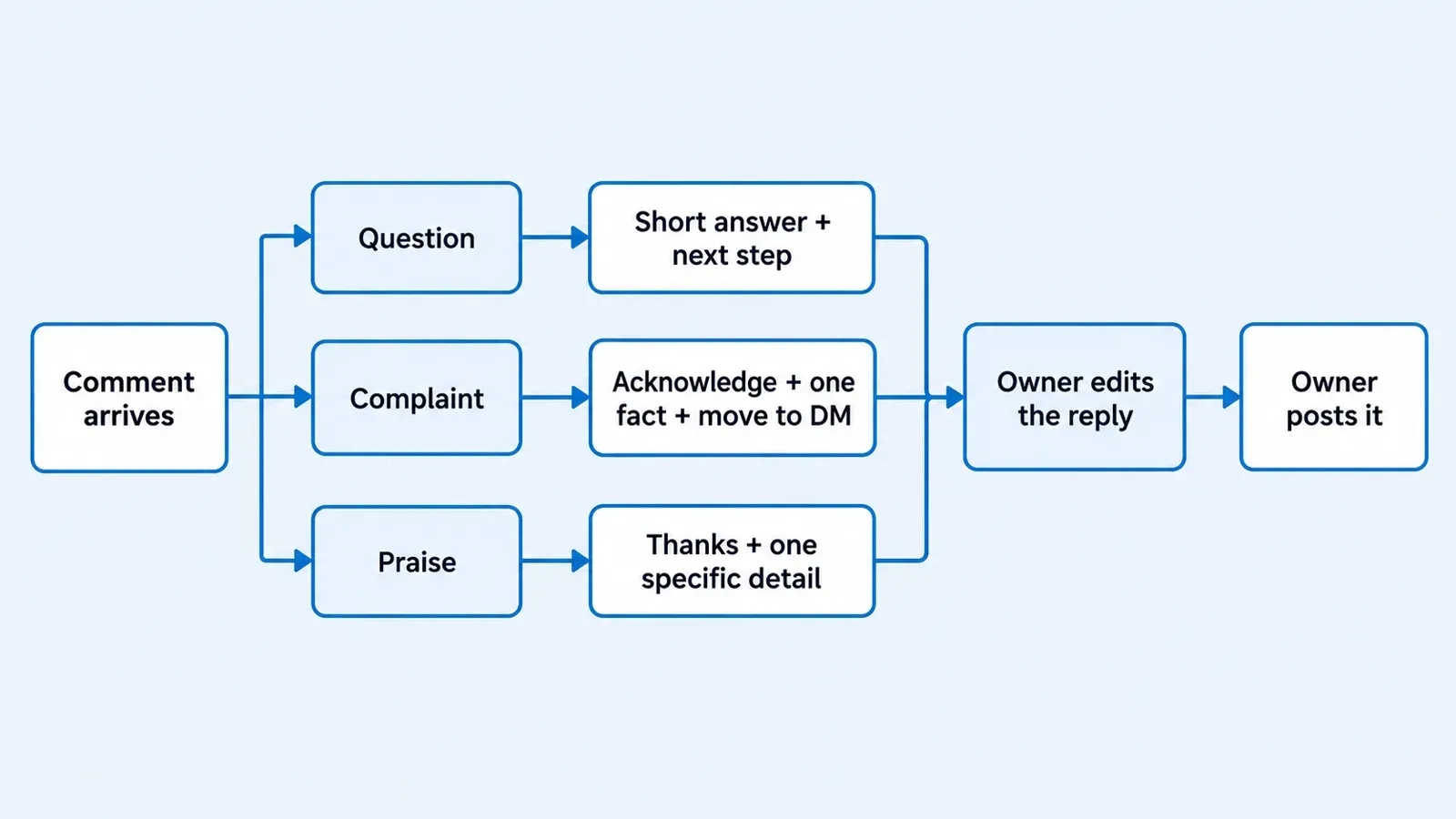
- Handle a public complaint in three moves: acknowledge, give one fact, move the detail to a private message.
- Invite comments with easy, specific questions about your own products, not 'comment below' demands.
- Comment on other accounts in your niche only when you have something to add, and never to point at your shop.
Good Instagram comment ideas for a small product brand are mostly replies: a short, specific answer to the question asked, one clear next step, and the same voice you use in captions. Write a few reply shapes in advance for the situations you see every week (ingredient questions, shipping questions, complaints, thanks), edit each before posting, and keep every reply honest. This article is for owner-run product brands where the owner is also the person answering comments.
You also need comment ideas that start conversations: prompts on your own posts, and thoughtful comments on other accounts. Both are covered below, with a table you can copy.
What counts as a good comment for a small brand
A good comment does one of three jobs. It answers a real question, it makes the person who wrote feel noticed, or it adds something useful to a conversation. If a reply does none of these, it is filler.
Three rules keep replies useful:
- Answer first. Put the answer in the opening words, then add warmth.
- Be specific. Mention the product, the detail, or the thing the person said. "Thanks so much!" could come from any brand; "Glad the lid fits your jar, that was the fiddly part" could only come from yours.
- Do not fake anything. No invented stock levels, no "only a few left" pressure, no asking friends to leave praise, and no paying for comments or likes. Bought engagement is not a conversation.
Comments also double as engagement post ideas. A question repeated three times in the comments is a ready-made post, which is covered near the end.
Comment and reply ideas by situation
The table below lists situations a small product brand meets often, with a hypothetical example reply for each. All examples are hypothetical: the brand, the product and the details in square brackets are placeholders you replace with your real facts.
| Situation | Hypothetical example reply |
|---|---|
| Thanks or praise | "Thank you! The [scent name] one is our favourite for [specific use]. Let us know how it burns down." |
| Ingredient question | "The full ingredient list is on the product page and printed on the label, so you can check it against what you need. Happy to point you to the exact line if useful." |
| Shipping question | "Orders go out [days you actually ship]. Delivery to [country] is shown at checkout, so you'll see the real figure before paying." |
| "Is this right for me?" | "Depends on [one factor]. If you tell us [one detail], we'll say honestly whether it fits, even if the answer is a different product." |
| Restock question | "We don't have a date yet. If you'd like to hear when it's back, [the sign-up method you actually have] is the best place." |
| Public complaint | "Sorry this arrived [problem]. That isn't what we want to send. Please message us your order number and we'll sort it out." |
| Wrong or confusing information | "Good catch, the page said [old detail]. It's now corrected. Thanks for flagging it." |
| Price comment | "Fair question. [One honest sentence on what goes into making it]. We'd rather explain it than discount it away." |
| Tagged by a customer | "Seeing it in your [setting] is a good surprise. Thank you for tagging us." |
| Comment you cannot answer | "Not sure, and we'd rather check than guess. We'll come back to you here by [day]." |
Notes on a few of these:
Ingredient questions. Point to the label and product page rather than describing what an ingredient does for someone's body. If a question is about an allergy, a medical condition or a reaction, say you can't advise on that and suggest the person check the label and speak to a qualified professional. Replies that read as health or result claims should be avoided.
Shipping questions. State only what you can stand behind. If you do not know a delivery date, say so and say where the information lives.
Price comments. Don't answer a price comment by inventing a deadline or a discount. A calm explanation of what the product is made from, or how it is made, is enough.
Handling a complaint in public
A public complaint is read by everyone who scrolls past, not just the person who wrote it. The goal is to show that complaints are handled properly, not to win the argument.
Use three moves:
- Acknowledge the specific problem. Name it ("the lid arrived cracked"), not a generic "we apologise for any inconvenience".
- Give one fact or one action. "Please send your order number" is a fact the person can act on.
- Move the detail to a private message. Addresses, order numbers and refunds don't belong in a comment thread.
Hypothetical example, for a complaint about a damaged item: "I'm sorry, a cracked lid is not what should arrive. Please send us a message with your order number and a photo, and we'll tell you what we can do." Only promise a replacement or refund if that is genuinely your policy, and keep the wording the same as your policy page.
Some things to avoid: deleting a fair complaint, arguing about the facts in public, or replying with a long defence. If a comment is abusive or spam, hiding it is reasonable. If it is simply unhappy, answer it.
Prompts that invite comments on your own posts
A prompt works when it is easy to answer in one line and relates to something you sell. Prompts that ask for a favour ("tag three friends") put the work on the reader. Questions that give the reader something to decide, remember or compare are easier to answer. No result is guaranteed.
Prompt ideas for a small product brand:
- A real choice. "Two lid options are on the table. Which would you use more?" Only ask if the answer will change something.
- A use case. "What do you keep this jar next to?" or "Where does this candle live in your home?"
- A small confession. "The part of making this batch we got wrong the first time was [detail]. What's a first attempt you still laugh about?"
- A pick-your-favourite. Show three options and ask which one gets used most, then answer every response.
- A question from last week's comments. Turn a repeated question into a post, and invite follow-ups.
- A behind-the-scenes ask. "Want to see how we pack an order? Say yes and we'll film it."
More ideas that start from what you sell are in AI social media post ideas from what you sell.
Two honest habits help. Reply to the first comments yourself, even briefly, so the thread shows that someone is reading. And don't run a "comment to enter" mechanic unless you are prepared to check Instagram's own current guidance first and run it fairly.
Commenting on other accounts without spamming
Commenting on accounts in your niche (other makers, a supplier, a shop you admire, a customer's post) can be worth the time, but only if the comment is useful to that account's audience even without your name on it.
A short test: would this comment make sense if the account did not know your shop existed? If not, don't post it.
Ideas that pass:
- Add one specific detail. "The way you show the wick trimming is the clearest I've seen" says something real.
- Answer someone else's question in a thread when you know the answer and it's not about your product.
- Ask a genuine question about a process or a material.
- Congratulate a launch without a pitch attached.
- Tag a customer's post with a thank-you, not a sales line.
Things to skip: "Check out our page", copied comments on many accounts, emojis alone, and links to your shop in someone else's comments. Keep it to a few considered comments a day, which is easier to sustain for one person than a long list.
Worked example: drafting reply templates from Business DNA (hypothetical)
This example is hypothetical. Imagine a hypothetical candle brand run by one owner who answers every comment and DM.
Step 1: Start with the voice. The owner has Youanai Social build a Business DNA profile from the brand's website. It captures the brand voice and offer rules, such as plain words, no exclamation overload, no discount language, and how shipping and returns are described on the site. The hypothetical profile says: calm, specific, and never pushy. Drafting replies is unconfirmed, so the profile is used as a style reference.
Step 2: List the situations. The owner writes down the ten situations from the table above and adds two specific to candles: "how long should I trim the wick?" and "can I burn it near a pet?" For the second, the owner decides the reply points to the safety guidance printed on the label and the product page instead of making a claim.
Step 3: Draft the templates. Using the voice and offer rules as the brief, the owner drafts one reply shape per situation. The aim is not word-for-word copy and paste, because identical replies may read as automated. It is a starting shape with gaps to fill: name, product, detail.
Step 4: Check against the rules. Each draft is read against the offer rules from the profile. Does it promise a refund that the policy page doesn't? Does it name a delivery time the owner can't guarantee? Does it use pressure language? Anything that fails gets rewritten. More on keeping the voice human is in captions that don't sound like AI.
Step 5: Approve, then use. In Youanai Social, post drafts wait for the owner's approval. Replies are not confirmed as a drafting feature, so here the owner reads, edits and posts each reply in Instagram. Each real comment gets a template as a starting point, then one personal sentence before posting. The approval habit is the same one described in approve to ship for one-person ecommerce social.
The result is a document the owner can adapt instead of writing each reply from scratch.
Turning comments into your next posts
Comments tell you what to post next, at no cost. Once a week, scan the last few posts and list:
- Questions asked more than once. These become a post or a carousel.
- Words customers use to describe the product. Use them in captions.
- Objections. Address them calmly in a post, with facts you can support.
- Photos customers mention wanting to see (the inside, the size, the packaging).
This is where engagement post ideas come from for a brand that doesn't have a content team. For a cadence that fits one person, see how often a one-person beauty brand should post on Instagram.
FAQ
What should a small brand comment on Instagram?
Comment something specific that helps: an answer, a thank-you that names a detail, or a genuine question. If the comment would read the same under any brand's post, add a detail or skip it.
How do I reply to a negative comment on Instagram?
Acknowledge the specific problem, give one action, and move the details to a private message. Don't delete a fair complaint or argue in the thread.
Should I reply to every comment?
Replying to every real question is a good aim for a small account. Short thank-you comments can get a brief, specific reply when time allows. Skip spam and abuse, or hide it.
Is it okay to use the same reply template every time?
Use templates as a starting shape, not a final answer. Change at least one detail per reply (the name, the product, or what the person said), so the reply reads as written for them.
How can I get more comments on my posts without buying them?
Ask easy, specific questions about your own products, reply to early comments, and turn repeated questions into posts. No approach guarantees a number of comments, and buying comments or likes is not worth it.
Can I comment on other brands' posts to get noticed?
Yes, if the comment adds something for that account's audience. Avoid pitches, links to your shop and copy-pasted lines.
How do I answer ingredient questions without making health claims?
Point to the full ingredient list on the label and product page, and describe what the product is, not what it does for someone's health. For allergy or medical questions, say you can't advise and suggest checking the label and speaking to a qualified professional.