
Insights
How to turn product photos into a week of Instagram posts
A camera roll is not a content plan. Sort photos by what they show, give each one a post job, reuse the keepers with new crops and captions, and read every caption before it goes out.
Aayush Lamichhane
Founder & CEO
6 min read
In short
- A photo becomes a post when it has one job: announce, explain, desire, trust or shop.
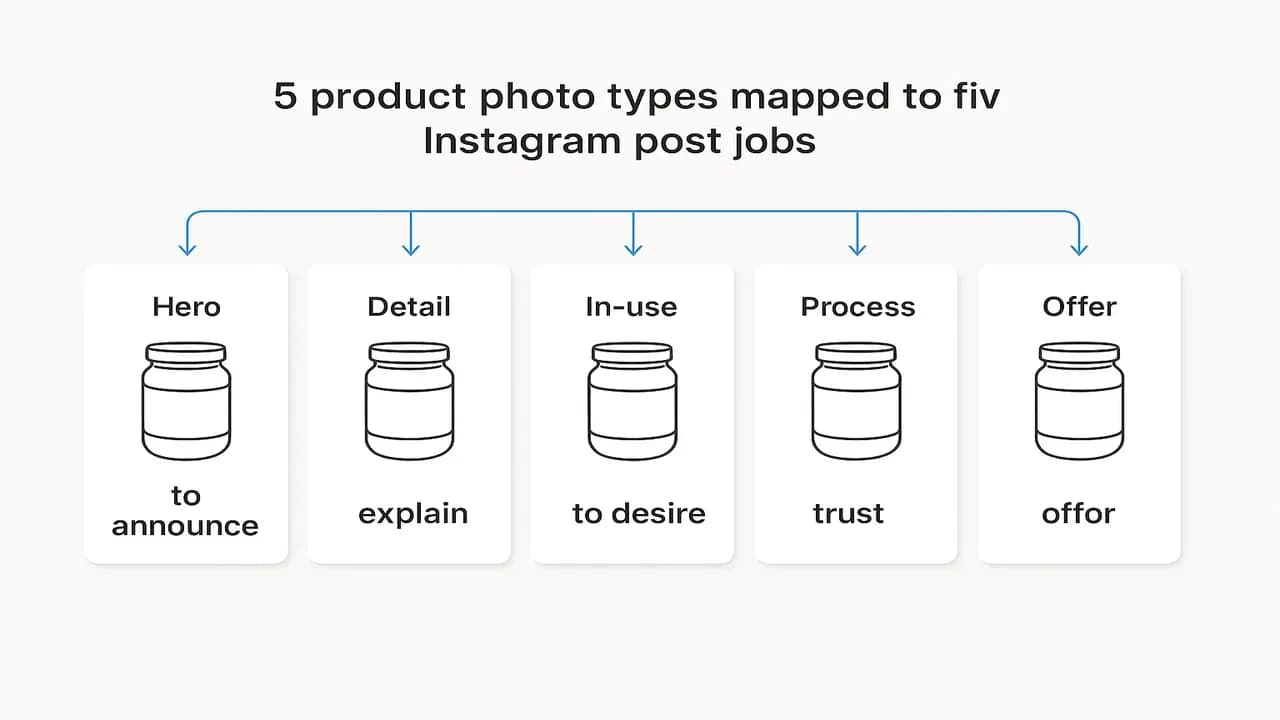
- Sort one product's photos into hero, detail, in-use, process and offer. Keep five at most.
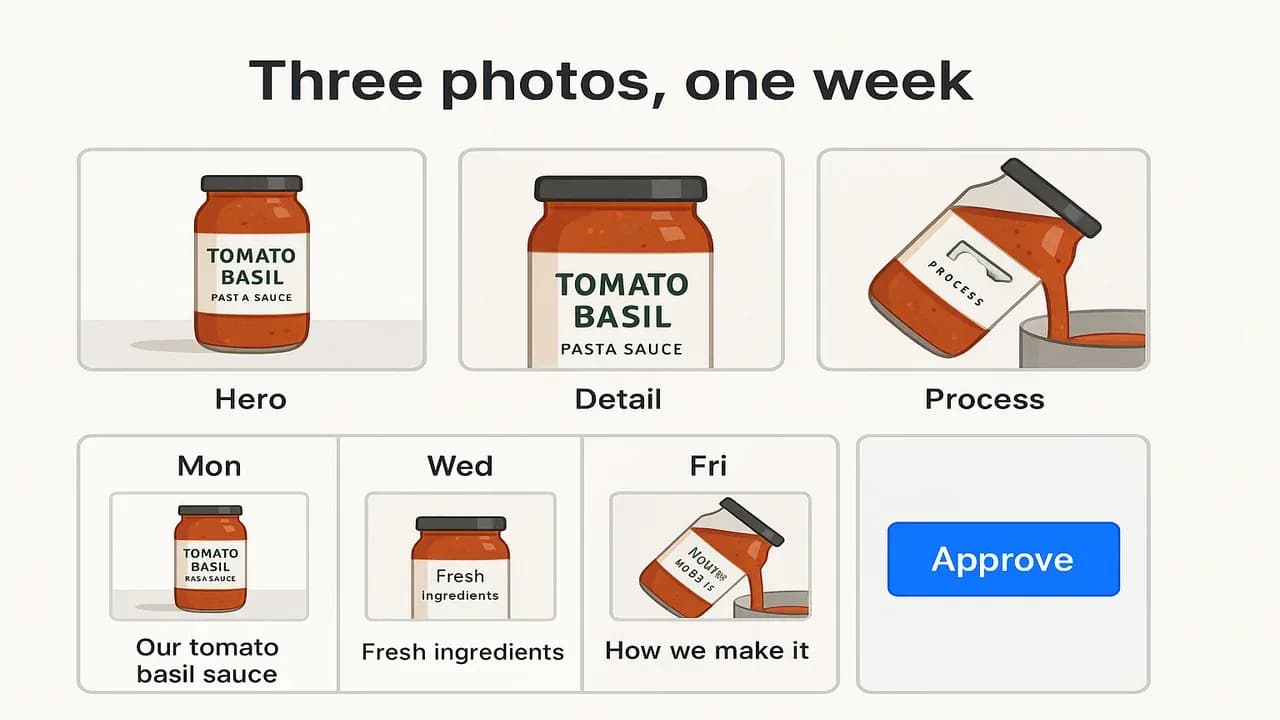
- Three photos (hero, detail, process) can fill a Monday to Friday week with different crops and captions.
- Write caption seeds from facts on the product page, then finish them in your own voice.
- Read and approve every caption before anything is scheduled or posted.
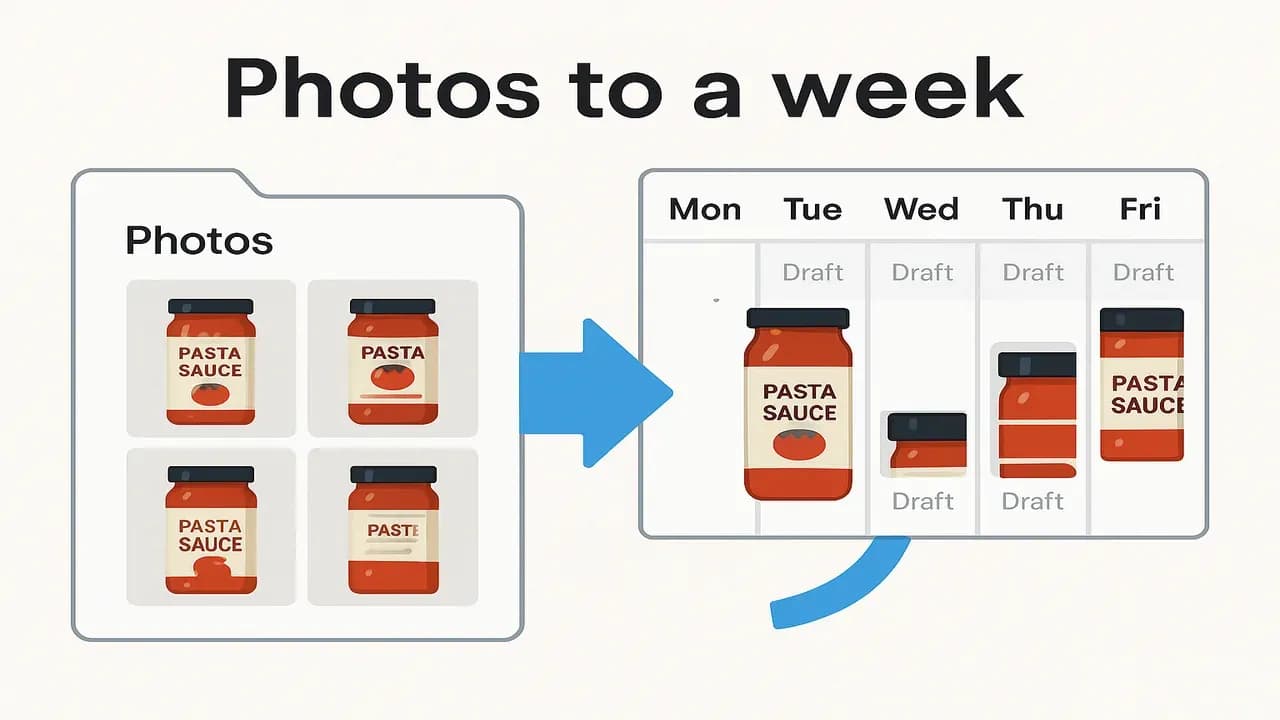
Give every product photo one job and a week fills itself. Sort one product's photos into five types (hero, detail, in-use, process, offer), match each to a post job, and reuse three to five keepers across Monday to Friday with different crops and captions. This is for owners of small product brands who have a full camera roll, an empty Instagram calendar, and nobody else to write the posts.
Audit the folder for one product
Open the album for one live product. Delete or park blurry near-duplicates, then sort what remains:
| Photo type | What it shows | Keep it if |
|---|---|---|
| Hero | Full product, clean background | The label is readable |
| Detail | Texture, lid, ingredient, stamp | One fact is obvious |
| In-use | The product in a real moment | The context is honest, not stock-fake |
| Process | Making, packing, labeling | It is real work you filmed |
| Offer | Bundle, restock, size option | The claim is true today |
Ecommerce photography guides treat pack shots and lifestyle stills as different jobs, not interchangeable crops (Shopify on ecommerce photography; Shopify how-to for product photos). Borrow that discipline: one clear job per frame.
If the folder is thin, a one-afternoon shot list covers it:
- Hero on a plain surface in window light.
- Detail of the label or lid.
- In-use: a plate, a desk, a pour, whatever matches the product.
- Process: packing tape, a ladle, a kiln shelf.
- Optional offer frame, such as two sizes side by side, only if the stock is real.
Stop at five keepers. More files rarely fix a blank week.
Match each photo type to a post job
Do not ask "what should I post?" Ask "what job does this photo already do?"
| Photo type | Post job | What to say |
|---|---|---|
| Hero | Announce | Name the product and who it is for |
| Detail | Explain | One fact from the product page |
| In-use | Desire | Show the moment, with no fake urgency |
| Process | Trust | Show the work, not generic B-roll |
| Offer | Shop | Restock, bundle or honest availability |
That map is the whole method. A week is five slots filled from those jobs, or three slots if that is all you can keep.
Build one week from three photos
The minimum set for a solo owner is hero, detail and process (or in-use, if there is no process photo). Reuse each with a different crop and caption. You do not need seven separate shoots.
| Day | Photo | Job | Caption seed |
|---|---|---|---|
| Mon | Hero | Announce | "New jar. Same Tuesday night pasta." |
| Tue | Detail | Explain | "That lid is doing more work than it looks." |
| Wed | Process | Trust | "Ladled, sealed, labeled. Then it leaves." |
| Thu | Hero, tight crop | Announce again | "Same sauce. Closer look at the label." |
| Fri | Detail or offer | Explain or shop | "Back for this week's orders" (only if true) |
Stories can borrow the same three frames. They do not count as a second week of ideas.
Hypothetical example (not a customer story): you sell a specialty pasta sauce called "Sunday Red, 16 oz." The camera roll has a clean jar hero, a tomato-and-herb detail, a stove pour and a packing shot. You skip inventing lifestyle filler. Monday announces the jar. Wednesday shows the ladle. Friday mentions a restock only if the shelf is actually full. For food brands with restock weeks, the specialty food restock week post goes further. Beauty brands can use the same map in the skincare weekly plan.
Instagram marketing guides from Shopify, Later and Buffer start from a small set of clear content types and a plan you can keep, not a dump of product tiles. Treat them as a floor for planning.
Write caption seeds from the product page
Start each caption from a fact on the product page, not from a prompt like "make it sound premium." Keep seeds short and finish them in your own voice. These caption seeds are hypothetical, for the pasta sauce example above:
- Hero: "New jar. Same Tuesday night pasta."
- Detail: "That lid is doing more work than it looks."
- In-use: "Plate night. No recipe essay."
- Process: "Ladled, sealed, labeled."
- Offer: "Two sizes. Same recipe. Stock is real."
Cut a caption if it does any of these:
- Says "Excited to announce..." with no product fact.
- Claims scarcity when inventory is fine.
- Could swap in any other brand name.
- Reads like an essay you would not say out loud.
For more on keeping drafts in your own voice, see captions that don't sound like AI. If your source is a product page rather than a photo folder, turning a product page into an Instagram week covers that route.
Draft the week and approve it
- Pick one live product and sort the folder into the five types.
- Match each keeper to a post job.
- Fill Monday to Friday, or three days, from five photos at most.
- Write caption seeds from the product page.
- Review each one as if a stranger will screenshot it.
- Approve, then schedule. Do not skip approval.
Youanai Social builds a Business DNA profile from your website (brand voice and offer rules) and drafts posts from it. Every draft waits for your approval before anything is posted. AI can draft. You still make the call.
FAQ
How many product photos do I need for a week of Instagram?
Three solid keepers can cover a week if you reuse crops and change the job of each post. Five is plenty. Ten blurry near-duplicates help less than one readable hero.
Can I reuse the same product photo with different captions?
Yes. The same hero as a Monday announcement and a Thursday tight crop is normal. Change the job or the fact each time. Do not post the identical frame with the identical caption five times.
Should I auto-post AI captions from product images?
No. Use AI to draft from your product facts, then read every caption and approve it before it publishes. Posting without review is how wrong claims and generic copy end up on your grid.
What is the difference between a pack shot and a post?
A pack shot proves the product exists. A post has a job: announce, explain, desire, trust or shop. The same photo becomes a post when you assign it a job and write a caption you approve.
What if I have no process or in-use photos?
Use hero and detail, and add a process or in-use shot when you next pack an order. Three days with real photos is better than five days padded with stock images. The afternoon shot list above covers the gaps.
Do I need an offer photo every week?
No. Post an offer only when the claim is true that day, such as a real restock or an available size. Skipping it keeps the week honest.
Keep reading
Instagram Comment Ideas for Small Product Brands

Reply examples for the comments a small product brand actually gets, from ingredient questions to public complaints, plus honest ways to invite…

10 min read
Cottage Food Law Illinois: Selling and Promoting Online
Illinois allows in-state online sales and shipping of cottage food, with registration, a CFPM and a set label. Here is what the…
10 min read
Ecommerce Product Photography at Home: A Simple Setup
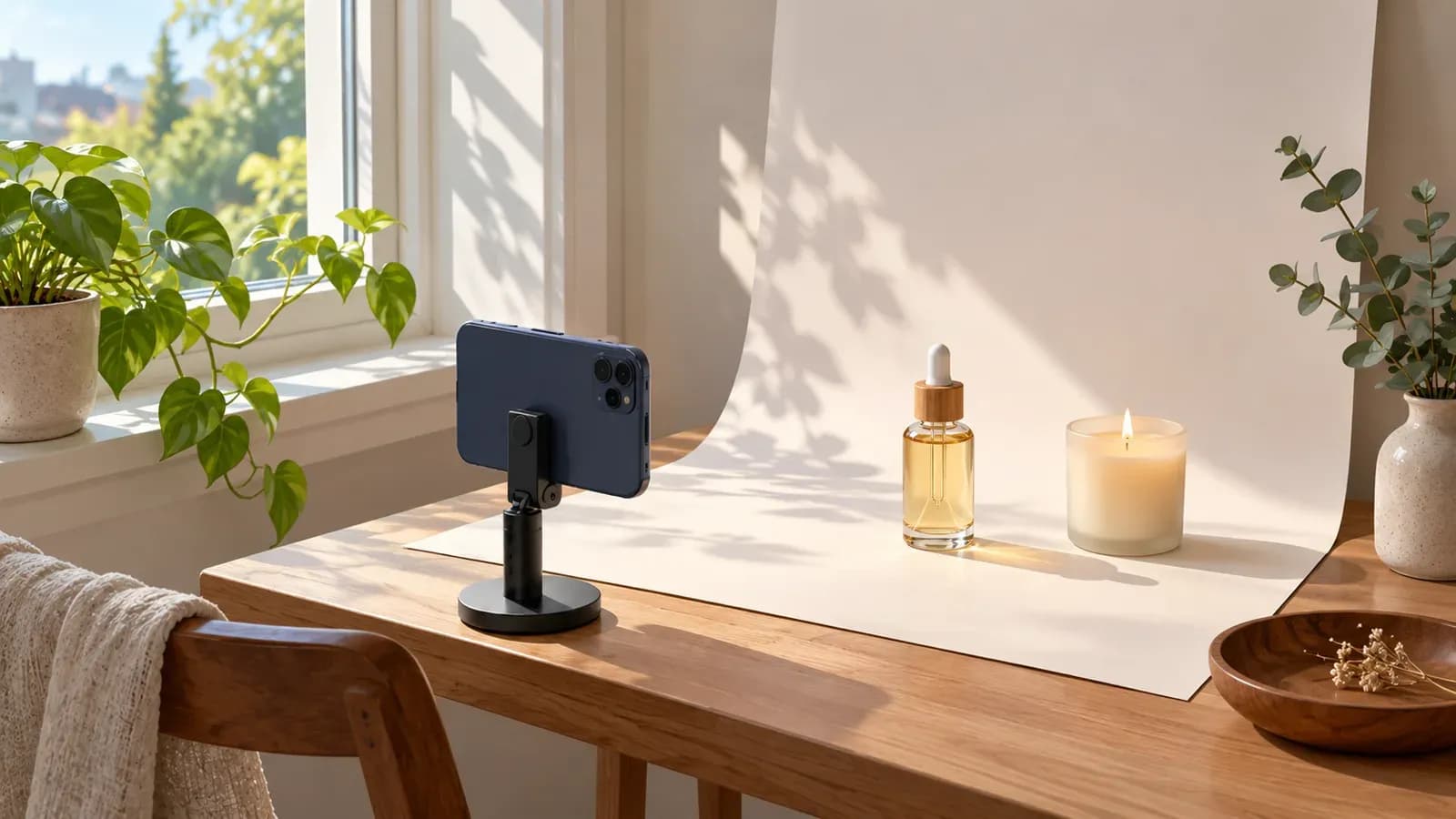
A phone, a window, a plain surface and a fixed shot list are enough to photograph a small catalogue consistently. Here is…

11 min read