
Social Workflows
Instagram Collab Post: How Two Small Shops Co-Post
A collab post puts two shops in front of each other's audiences, but only if the idea, the wording and the sign-off are settled first. Here is a plain routine for two owners, with a two-owner approval check.
Aayush Lamichhane
Founder & CEO
10 min read

In short
- An Instagram collab post is one post shared between two accounts, so two shops can show it to both audiences. Check Instagram's own help pages for the current steps.
- Pick a partner whose customers overlap with yours without competing for the same sale.
- Agree on the idea, the caption, the offer wording and the timing in writing before anything is drafted.
- Run an approval check where both owners sign off on the final post. One owner's yes is not enough.
- After it goes out, look at the same few measures each time and decide together whether to repeat.
An Instagram collab post is a single post shared between two accounts, so two shops can show the same content to both audiences. For a small shop, the useful part is not the feature itself but the agreement behind it: which shop, which idea, which wording, and a sign-off from both owners before anything goes out. This article is for owners of small product brands who are also the whole marketing team and are thinking about co-posting with another shop.
You will leave with a routine you can run in a week: how to choose a partner, what to agree on, a two-owner approval check, and what to look at afterwards.
What a collab post is, and what it is not
The idea is simple. Instead of each shop posting its own version of the same news, one post is shared between two accounts. Each shop's audience can meet the other shop through content that already feels relevant.
A few points are worth keeping straight:
- It is a feature of Instagram, and Instagram changes it. Menu names, options and rules can shift. Before you start, check Instagram's own help pages for the current steps and what is supported right now. This article describes the idea, not the buttons.
- It is not a substitute for a good post. A weak photo posted by two shops is still a weak photo.
- It is not a contract. Nothing about the feature records what the two owners agreed. That part is up to you, which is why the written agreement below matters.
If you are still working out how often to post at all, settle that first. How often a one-person beauty brand should post on Instagram covers choosing a rhythm you can keep, and a collab post then becomes one planned slot in it, not an extra scramble.
Choose a partner shop that fits
The best partner is a shop whose customers might also like yours, but who is not selling the same thing to the same buyer. Think of neighbours, not rivals.
Questions that help:
- Would a customer of the other shop plausibly buy from you? A hypothetical candle maker and a hypothetical ceramic mug maker share a gifting moment without competing.
- Is the brand feel close enough? Two shops with very different tones can still work, but the post has to bridge them.
- Is the other owner reliable? A collab needs two people to reply, approve and post on time. Think about how the owner handles messages and deadlines before proposing anything.
- Is the effort even? If one shop does all the drafting and the other only approves, say so openly, so the arrangement stays fair.
Start small. One post with one partner teaches more than a plan for a whole series, and it is easier to say yes to.
Agree on the post before anyone drafts it
Most collab trouble comes from two owners assuming different things. A short written agreement, even a few lines in a shared note or a message thread, prevents most of it.
| Agree on | Why it matters | Example question |
|---|---|---|
| The idea | Keeps the post about something real for both audiences | What is the one thing a viewer should take from this post? |
| Who drafts | Avoids two competing versions | Which owner writes the first draft? |
| Caption and tone | Each shop wants to sound like itself | Is the voice shared, or one owner's? |
| Any offer or claim | Prevents a promise one owner did not mean to make | Is there an offer, who funds it, and what exactly does it say? |
| Product claims | Some products need extra care with wording | Does every claim hold up for both shops' products? |
| Timing | Both owners need to be ready to approve and post | What day does it go out, and who has the final say on that? |
| What happens if something changes | Gives both owners a way out | Can either owner pause the post if circumstances change? |
Keep the agreement short enough that both owners will actually read it. A page of terms nobody opens does not protect anyone.
On claims in particular: if either shop sells skincare, food or anything similar, agree to keep the language plain and avoid promises about results. When in doubt, leave the claim out.
Draft the post
Once the idea is agreed, one owner writes the first draft and the other reviews it. A few practical habits help.
- Lead with the picture and the point. The viewer should understand in a moment what the two shops are doing together.
- Write for a stranger. The partner's audience does not know your shop yet. Say what you make in plain words, and why the two shops belong in one post.
- Keep each shop's voice recognisable. A shared caption does not have to be bland. Two short lines, one from each owner, can keep both voices.
- Keep one call to action. Pick the one next step you want a viewer to take and leave the rest out.
If a blank page is the slow part, a tool can help with the first draft. Youanai Social builds a Business DNA profile from your website, capturing brand voice and offer rules, and drafts social posts from it. Every draft waits for the owner's approval before anything is posted, and there is a free way to start. Use it to get your side of the caption in your own voice, then share it with the partner shop for review. For more on turning what you sell into post material, see AI social media post ideas from what you sell.
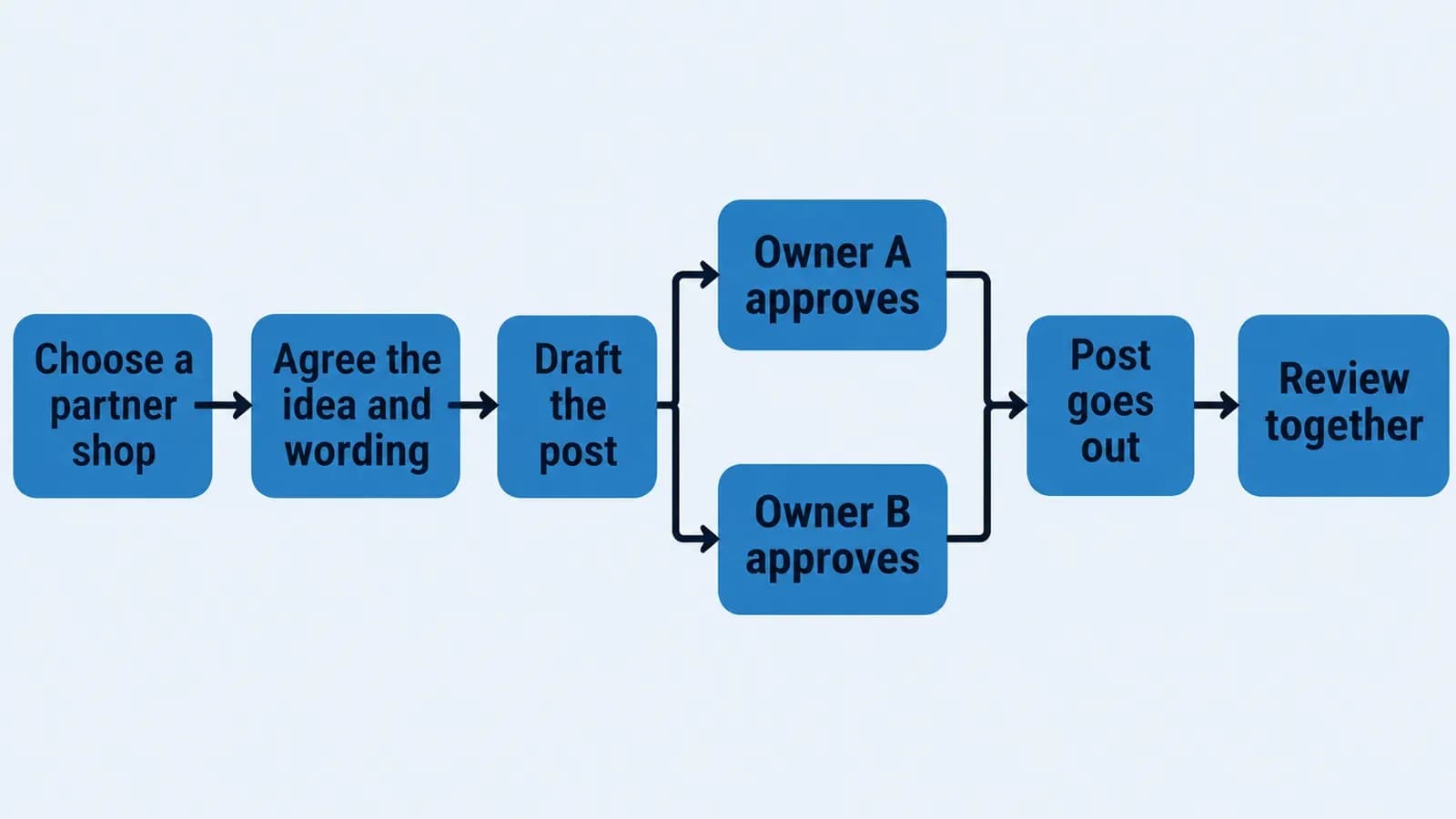
The two-owner approval check
This is the step most small shops skip, and the one that protects both brands. A collab post carries two names. Either owner's name can be attached to something the other did not mean to say, so both owners approve the final version, not only the idea.
Run it like this:
- Freeze the draft. Once both owners have seen the near-final version, stop editing. Changes after sign-off are how mistakes slip in.
- Each owner checks the same list, separately. Do not rely on one owner reading it for both.
- Each owner replies with a clear yes. A thumbs-up on a message that has since been edited does not count. Reply to the frozen version.
- Only then does the post go out. If either owner says no or wants a change, go back to step 1 with a new frozen draft.
A checklist both owners can use:
| Check | Owner A | Owner B |
|---|---|---|
| The image shows only products and content we are allowed to use | Yes or no | Yes or no |
| Every product claim is accurate and safe to say | Yes or no | Yes or no |
| Any offer is worded the same way in both owners' notes | Yes or no | Yes or no |
| Spelling of both shop names, tags and links is correct | Yes or no | Yes or no |
| The posting day and time work for both | Yes or no | Yes or no |
| The post matches what was agreed in writing | Yes or no | Yes or no |
Two owners with two separate checks catch more than one owner checking twice. This is the same idea as an approval step for a single account; approve to ship for one-person ecommerce social shows how a short routine keeps drafts from going out unreviewed, and a collab simply adds a second reviewer.
Worked example (hypothetical)
This example is hypothetical, with two invented shops, to show the steps. It contains no real results and none are claimed.
Imagine a hypothetical candle shop and a hypothetical ceramic mug shop, each run by one owner. Both sell gifts and neither sells the other's product.
Partner choice. The candle owner messages the mug owner with a one-line idea: a post showing a candle inside a mug as a gift pairing. The mug owner agrees to try one post.
Agreement. In a shared note, the owners write down the idea, that the candle owner drafts the first version, that the caption carries one line from each shop, that no offer is included, and that the post goes out on a weekday the candle owner proposes and the mug owner confirms.
Drafting. The candle owner uses Business DNA from the shop's website to draft a caption in the shop's own voice, then edits it by hand and sends it with the photo to the mug owner.
Review. The mug owner changes one line so it sounds like the mug shop, and fixes the spelling of the shop name. The candle owner accepts the change. The draft is frozen.
Approval. Each owner goes through the checklist separately and replies yes to the frozen version. Only then is the post set up in Instagram, following Instagram's current steps from its help pages.
Afterwards. The owners decide in advance to look at the same two measures on the owners' own accounts, such as saves and replies, and to talk for ten minutes about whether to do another.
Whatever the outcome, both owners end up with a post both agreed to, and a clear idea of whether the partnership is worth repeating.
After the post goes out
Afterwards, keep the review light. Pick the measures before the post goes out, so the result cannot be bent to fit afterwards.
- Look at the same measures on both accounts. Saves, shares, replies and visits to the shop are examples. Compare notes in a message, since each owner sees the figures for that owner's own account.
- Read the replies. Comments and messages often say more than numbers: who asked about what, and which product caught attention.
- Decide together. Repeat, adjust, or stop. Any of those is a fine outcome, and stopping politely is better than drifting into a half-hearted second post.
If you would like to fit the next collab into a regular rhythm, turning product photos into an Instagram week shows how to plan the rest of the week around it, so the partnership post is one of several planned posts and not the only one.
FAQ
What is an Instagram collab post?
An Instagram collab post is a post shared between two accounts, so both shops can put the same content in front of both audiences. The exact options and rules are set by Instagram and can change, so check Instagram's own help pages for the current steps.
How do two shops make an Instagram collab post?
Agree on the idea, wording and timing first, draft and approve the post with both owners, then set it up in Instagram following the steps on Instagram's help pages. Those steps can change, so use the current version from Instagram, not a screenshot from an old guide.
Who should I do a collab post with?
Choose a shop whose customers might also like yours, but which does not sell the same thing to the same buyer. A reliable owner who replies and approves on time matters as much as a similar audience.
Do both owners need to approve a collab post?
Yes, as a rule of good practice. A collab post carries two shop names, so each owner should check and approve the final frozen version separately. Instagram's own steps are separate from this agreement between you and the partner.
What should we agree on before posting?
Agree on the idea, who drafts, the caption and tone, any offer or product claim, the posting day, and what happens if something changes. A few written lines in a shared note are enough.
Can I draft my half of a collab post with Youanai Social?
Yes, for drafting your own caption. Youanai Social builds a Business DNA profile from your website and drafts posts from it, and every draft waits for your approval before anything is posted. The partner shop's review and sign-off still happen between the two owners.
How do I know if a collab post worked?
Choose the measures before the post goes out, such as saves, replies or visits to your shop, and compare notes with the partner owner afterwards. One post is a small sample, so treat the result as a hint and not as proof.
Keep reading
What to Post on Facebook: A Weekly Mix for Small Brands

A one-person product shop does not need a big content plan for Facebook. Pick a few post types that suit the page,…

9 min read
Starting a Candle Business: Social Media for Your First 90 Days

A three-phase plan for the first 90 days of a candle brand: what to post before launch, how to photograph candles with…
10 min read
Later Alternative: Buffer vs Later for Small Product Shops

A plain look at Later and Buffer for an owner-run shop: what each plan lists, what each costs as of 2026-11-03, and…

10 min read