
Insights
How Often Should a Small Beauty Brand Post on Instagram?
A weekly pace for an owner who is also the photographer and the packer: which band to pick, how to spread the posts, a hypothetical serum week, and when it is safe to post more.
Kushal Shrestha
Marketing & Engineering
6 min read
In short
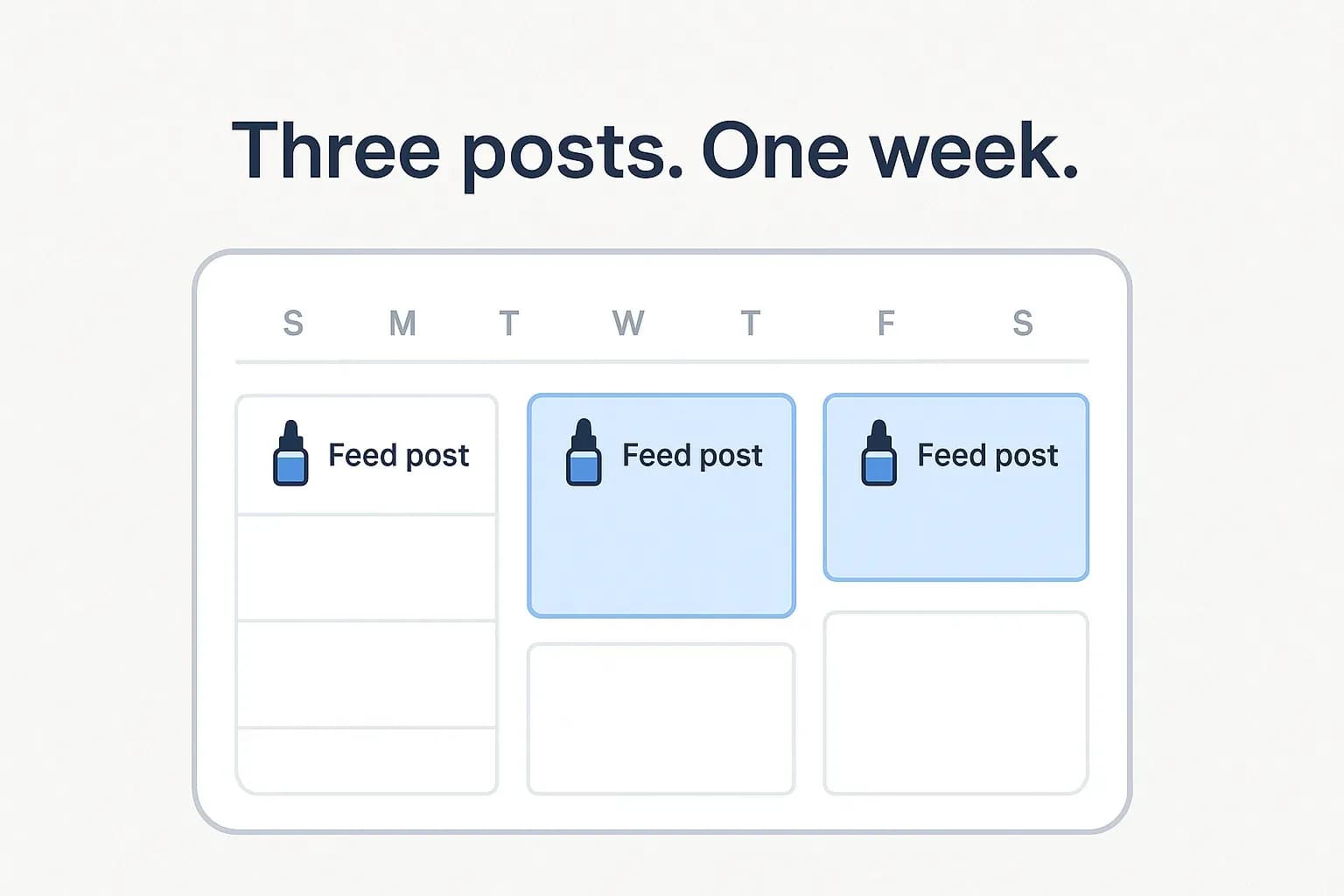
- Start at three feed posts a week and hold it for four weeks before raising it.
- Drop to one or two in shipping or crunch weeks. Avoid weeks with no posts at all.
- Give each post one job: educate, prove or shop. Spread them across the week.
- Keep Stories light and true. They sit beside the feed number, not inside it.
- Batch once on a set day, say each caption out loud next to its photo, and approve before anything is scheduled.
Start at three feed posts a week and hold that pace for four weeks before you raise it. Drop to one or two in shipping or crunch weeks, and avoid weeks with no posts at all. This is for the owner of a small beauty or skincare brand who is also the photographer, the writer and the person packing orders.
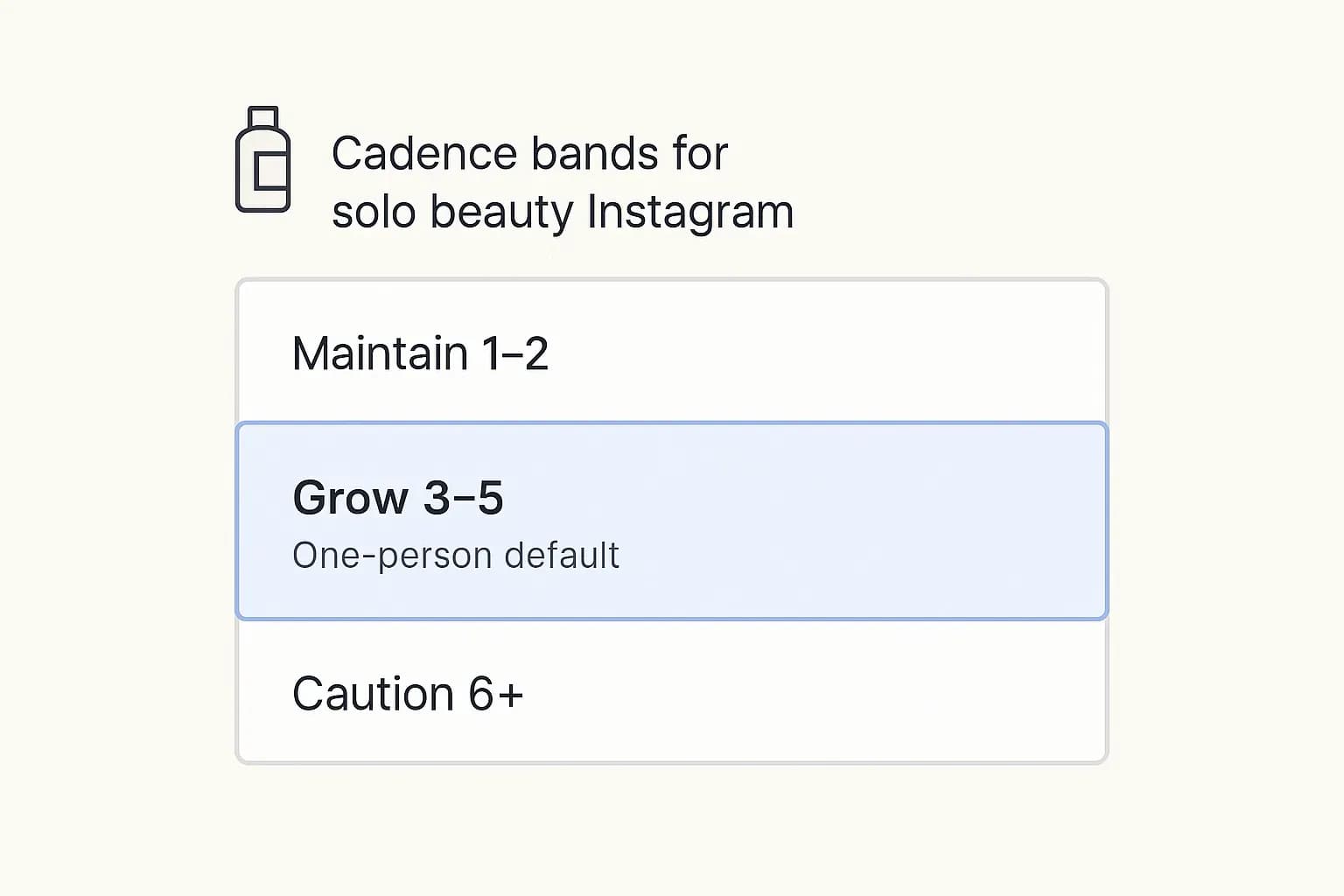
Public guidance backs a modest number. Buffer's large Instagram study puts sustainable growth near 3 to 5 feed posts per week, with 1 to 2 as maintain and 6 to 9+ only if quality holds (Buffer on how often to post). Shopify lands in the same band and treats Stories as a lighter daily habit when useful (Shopify guide). Dash Social's beauty benchmarks put top-performing beauty brands at about five weekly feed posts (Dash how often; Dash beauty benchmarks). Use these as a floor. A media brand's volume does not transfer to a one-person shop.
Pick a weekly band
| Band | Feed posts / week | When it fits a solo beauty brand | What goes wrong |
|---|---|---|---|
| Maintain | 1 to 2 | Shipping weeks, travel, a reformulation crunch | Going quiet for long stretches |
| Grow (default) | 3 to 5 | Normal weeks with real photos on hand | Chasing five posts with empty captions |
| Caution | 6 to 9+ | Only if every post still passes the stranger test | Daily filler that could sell anyone's serum |
The stranger test: would a caption still make sense if another brand's product name replaced yours? If so, it is too generic to post.
Stories sit beside this number, not inside it. Use light, true frames on days you already have the phone out: packing an order, a shade swatch, one reply to a customer question. Lives are optional and rare.
Three specific posts beat ten half-true ones. In the author's view, steady weeks matter more than one big weekend of posting. Buffer also flags a "no-post penalty": weeks with zero posts underperform that account's own baseline (Buffer).
Set the week in five steps
Lock the band before you open a caption tool.
- Pick the band. Maintain, grow, or (rarely) caution.
- Name the job of each post. Educate, prove or shop. One job per post.
- Spread the posts. Monday, Wednesday, Friday or Tuesday, Thursday, Saturday. Three posts dumped on Sunday night is not a weekly pace.
- Batch once. One block to capture, one to edit, one to approve.
- Raise only after four clean weeks. If you held three posts with specific captions every week, try four.
Habits that waste a small brand's time:
- Posting daily "because of the algorithm"
- Matching a celebrity beauty account's volume
- Five product flat-lays with no ingredient or use fact
- Announcing a "limited drop" when the shelf is full
- Scheduling without an approval pass
Build the week from what you already have
Start from what is true on your bench and in your camera roll, not from a list of content ideas.
| Input | Ask | What it decides |
|---|---|---|
| Photos on hand | What can you show without a new shoot? | Your weekly count |
| Product facts | Actives, texture, shade, size, batch note | What the educate and prove posts say |
| Orders and calendar | Launch, restock or quiet week? | Maintain or grow band |
| Time this Sunday | Do you have 90 minutes free? | Your batch window |
Caption seeds to fill in, then read aloud:
- "Vitamin C serum. AM after cleanser. SPF after."
- "Same dropper. Same glass. Same formula as last lot."
- "Two sizes. Ships today. Link in bio."
Keep claims to what the product is and how it is used. Leave out promises about what it will do for skin.
Worked example: a hypothetical serum week
Hypothetical, not a customer story: you sell "Lanewell Glow Serum", a 30 ml vitamin C serum. Photos on hand: bottle hero, texture swipe, packing table. You have about 90 minutes on Sunday. The target band is grow, at three posts.
A weak week (hypothetical): nothing from Monday to Thursday, then four lifestyle captions on Friday that never name the serum.
A better week (hypothetical):
| Day | Job | Caption seed | Photo |
|---|---|---|---|
| Mon | Educate | Vitamin C after cleanser. SPF after. That is the morning order. | Texture swipe |
| Wed | Prove | 15% ascorbic acid. Same formula as last lot. | Bottle hero |
| Fri | Shop | 30 ml. Ships today. | Packing table, both sizes |
Check each post before it goes into the schedule:
| Check | Pass when |
|---|---|
| Specific noun in the first line | Serum, ascorbic acid, dropper or SPF is named |
| Cadence held | Three separate days, not a Friday dump |
| Voice test | You would text each line to a regular customer |
| Approval | You said yes to every post before scheduling |
A cream, balm or color product uses the same grid: swap the noun and the use line. The example is illustrative; use your own formulas and numbers, and keep any ingredient claim to what your label says.
Run a Sunday batch that survives Monday
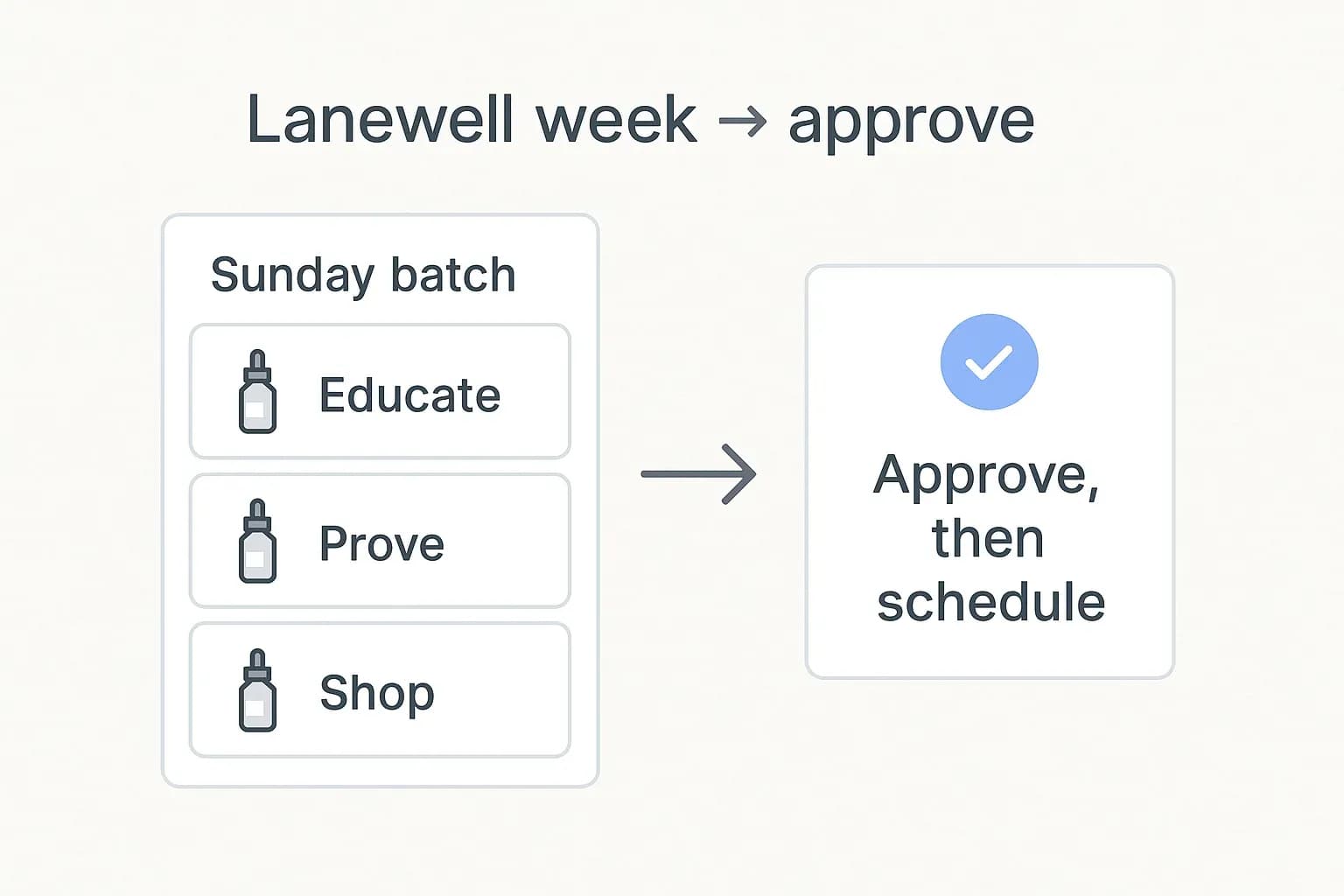
- Pull three photos and three true facts.
- Assign a job to each: educate, prove, shop.
- Draft the captions. A tool can write a first pass; the owner makes the final call.
- Read each line aloud next to its photo. Rewrite anything you would not say.
- Approve the set, then schedule it for your three days.
If drafts all sound alike, the fix is in the inputs, not the pace. See how to write captions that sound like your brand. To map one product across a week, use the weekly content plan for a skincare brand. If the calendar is simply empty, start with filling an empty ecommerce calendar.
Youanai Social builds a Business DNA profile from your website, drafts posts from it, and holds every draft until you approve it. The approval step is covered in more detail in approve before it ships.
FAQ
How often should a small beauty brand post on Instagram?
Start at three feed posts per week for four weeks. If quality holds, move toward four or five. Stay at one or two during a shipping crunch, and treat six or more as a caution, not a goal.
Do beauty brands need to post every day?
No. Top-performing beauty brands average around five weekly feed posts in Dash Social's public benchmarks, not seven (Dash beauty). Daily Stories can help you stay visible, but they are not a second feed quota.
How many Reels versus static posts should I make?
A mix is fine: one Reel and two carousels, or two Reels and one still. Public guides often favor Reels for reach (Shopify; Dash). If you only have a clear bottle photo, post the still with a true caption instead of forcing a Reel.
What should I do if I miss a week?
Post one honest update when you are back, then return to three the next week. Do not make up for it with five filler posts in a day. Buffer finds that a week with no posts costs more than a quiet maintain week (Buffer).
Should I post more when I launch a product?
Not by default. Keep the band you can hold and spend the extra effort on better photos and facts for those three slots. If you do go higher for a launch week, plan the drop back to your normal pace beforehand.
How is posting frequency different from a content plan?
Frequency sets how many slots you open each week. A content plan decides what goes into them. Set the cadence first, then fill the slots with one job per post.
Can I use AI to write the captions?
Yes, for a first draft. Check each caption against your product facts, read it aloud, and approve it yourself before anything is scheduled.
Keep reading
Instagram Comment Ideas for Small Product Brands

Reply examples for the comments a small product brand actually gets, from ingredient questions to public complaints, plus honest ways to invite…

10 min read
Cottage Food Law Illinois: Selling and Promoting Online
Illinois allows in-state online sales and shipping of cottage food, with registration, a CFPM and a set label. Here is what the…
10 min read
Ecommerce Product Photography at Home: A Simple Setup
A phone, a window, a plain surface and a fixed shot list are enough to photograph a small catalogue consistently. Here is…

11 min read