
Insights
AI Social Media Post Ideas From the Products You Sell
A blank calendar is usually a product-facts problem. Write one fact card, split it into five idea seeds, give AI a short brief, and keep only the ideas that pass a simple check.
Aayush Lamichhane
Founder & CEO
7 min read
In short
- Start from one product you can ship this week, not from a blank AI prompt.
- Write a fact card: what arrives, who it is for, one detail from the page, one proof line, claims you will not make.
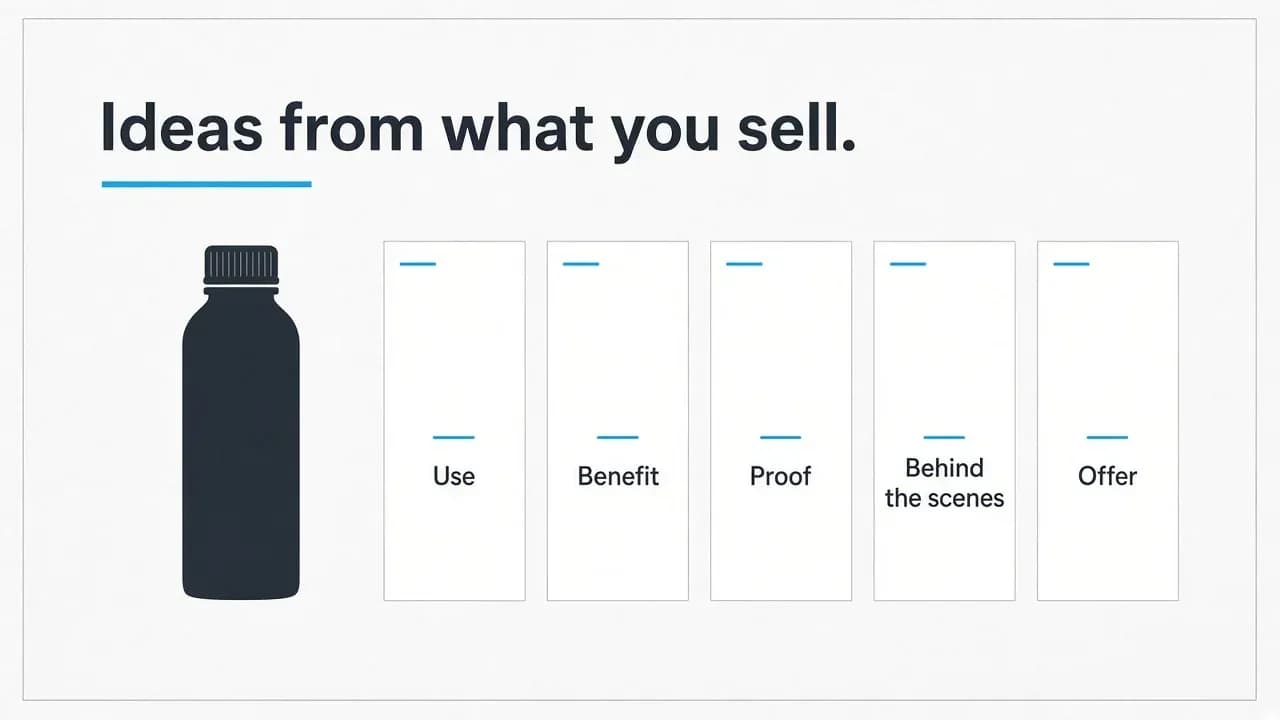
- Split the card into five seeds: use, benefit, proof, behind the scenes, offer.
- Give AI a short brief with the seeds and your rules, and ask for drafts you will edit.
- Cut any idea that is vague, urgent without cause, or not supported by your product page.
- Approve what ships yourself, then schedule.
Take one product you can ship this week, write down its facts, split them into five idea seeds, and only then ask AI to expand the seeds into draft captions. This works for owner-run shops with a blank calendar and a live product page. The ideas come from what you already sell, so there is nothing to invent and little to fix afterward.
If you have searched for how to create social media post ideas with AI and found a list of apps instead of a method, this is the method.
Start with one product, not a blank prompt
Open your store admin or a spreadsheet of live products. Pick one product you can ship now. Skip anything still waiting on packaging, claims or photos you do not own.
Before you open any AI tool, write a fact card:
- Product name and current product-page URL
- What arrives in the order (size, pack count, extras)
- Who it is for, in one plain sentence
- One ingredient, material or construction detail from the page
- One proof line you can support (a review quote, a restock note, a process fact)
- Claims you will not make
The card is your source of truth. Public guides on product-led social for Shopify stores make the same point: catalog pages, variants, care notes and real buyer questions beat generic content-idea lists (IDEQO, 2026; AttentionClaw on product-page questions).
Hypothetical example, not a customer story: a small hot-sauce brand. The live product is "Smoked Chili Hot Sauce, 5 oz." The page says smoked chili and garlic, heat for people who want flavor first, and a pour-spout tip in the box. The owner has six product photos and two packing shots, no content team, and one Friday afternoon to fill next week.
If your product page is thin, the card will show it. Fixing the page first is a fair use of the hour. The post turning a product page into a week of Instagram posts shows how a page feeds a full week.
Turn one product into five idea seeds
Use the same five seeds for any product. Fill them from the fact card.
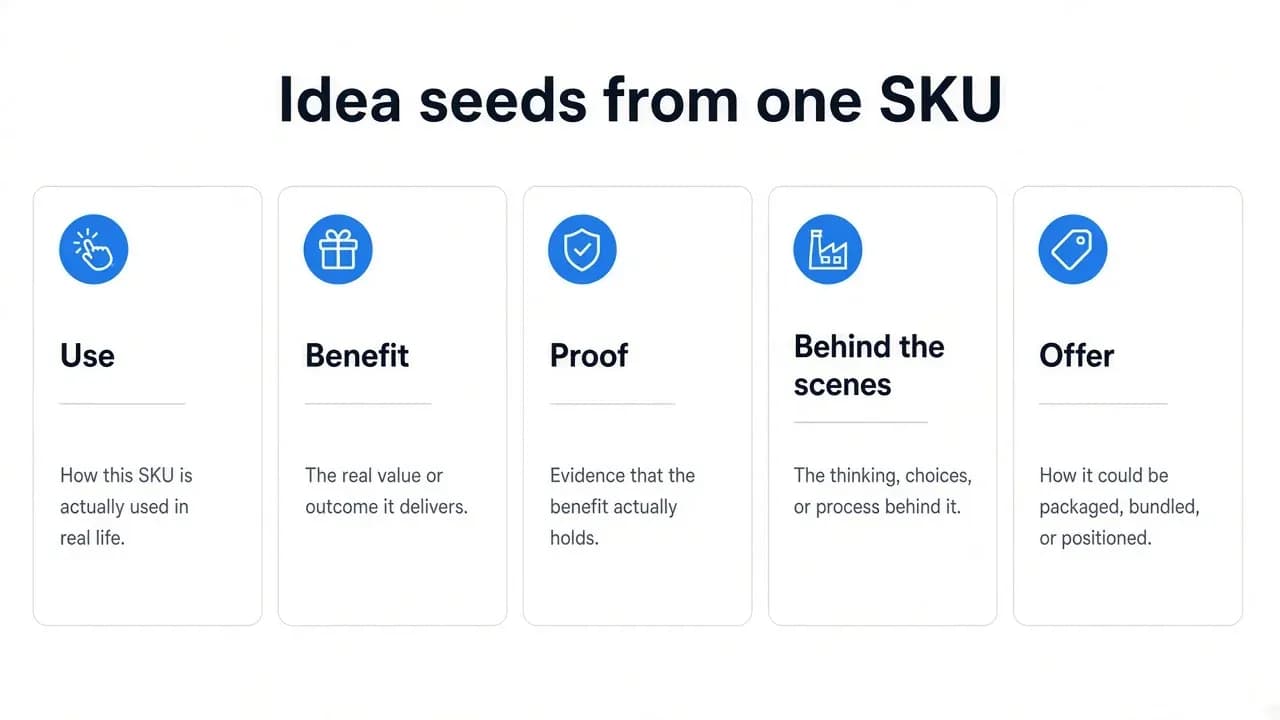
| Seed | Job | Hot-sauce example (hypothetical) |
|---|---|---|
| Use | Show one real moment of use | Two drops on eggs, then stop |
| Benefit | Name the outcome without hype | Smoke first, heat second |
| Proof | Show evidence you already have | Quote a real review or restock note |
| Behind the scenes | Show process or packing | Filling bottles, sealing, labeled boxes |
| Offer | Honest availability or bundle | "5 oz back in stock; tip included" |
A copyable worksheet:
- Product: _______________
- Use seed: _______________
- Benefit seed: _______________
- Proof seed (source: _______________): _______________
- Behind-the-scenes seed: _______________
- Offer seed (only if true today): _______________
If you can write five seeds from one product without opening a tool, the AI step will stay useful. If you cannot, the tool will fill the gaps with generic filler.
Merchant tooling frames a month of content the same way: a few products times several angles, not thirty random prompts (IDEQO month guide). Borrow the structure and keep your own facts.
Give AI a short brief
Paste a brief, not your whole brand history. For the hypothetical hot sauce:
Product: Smoked Chili Hot Sauce, 5 oz
Who it's for: home cooks who want smoke before burn
From the page: smoked chili, garlic, pour spout tip included
Proof I can use: [paste one real review line or omit]
Seeds to expand: use / benefit / proof / behind the scenes / offer
Rules: no "elevate", no fake urgency, no medical claims, short captions, sound like a person who bottles sauce
Output: 5 caption drafts and one shot suggestion each. Label each with its seed.
Ask for seeds and caption drafts you will edit. Do not ask it to "sound premium" or "go viral"; those instructions produce the generic copy you were trying to avoid. Keep inputs short: title, who it is for, one ingredient or material line, one proof line. Extra adjectives do not help.
If you want the brand voice and offer rules written down once instead of pasted every time, Youanai Social builds a Business DNA profile from your website and drafts posts from it. Use it after the method works on paper, not instead of the fact card.
Check each idea before you draft
Cut any idea that fails one of these checks:
- A vague claim ("premium flavor journey") with no product fact behind it
- Urgency ("selling out fast") when stock is fine
- Agency-speak ("elevate your routine," "unlock bold taste")
- A claim that is not on your label or product page
- A caption that would fit any brand if you swapped the product name
Keep ideas that name the product, the moment of use, or a proof line you can show in the frame. One specific sentence beats three vague ones.
Two hypothetical captions for the same product:
- Generic: "Elevate your culinary journey with our artisanal heat."
- Specific: "Two drops on scrambled eggs. Smoke first."
Before anything ships, read the caption out loud, cut filler, and check that the product page still matches what you said. For a longer list of what to cut, see captions that don't sound like AI.
Draft, approve, then schedule
The order for a solo owner:
- Write the fact card from your product page.
- Write five seeds on paper.
- Let AI expand the seeds into draft captions and shot notes.
- Score and rewrite them yourself.
- Approve what ships.
- Schedule it.
Do not auto-post AI output. Approval is where you catch wrong claims and a voice that is not yours. The article on approving drafts before they ship covers that loop for one-person shops.
Beauty brands have extra claim-safety concerns, so for skincare use the weekly content plan for a skincare brand. If the calendar is already empty and you need a first week, fixing an empty content calendar is the next read.
FAQ
Can AI create social media post ideas from my product list?
Yes, if you give it real product facts. AI is good at expanding a product card into several angles and weak at inventing claims you can stand behind. Start with the fact card, then ask for seeds.
What should I give an AI tool so ideas don't sound generic?
Give it the product title, who it is for, one ingredient or material line from the page, one proof line you can support, and firm rules about tone. Skip "make it engaging." Say what you refuse: fake urgency, empty adjectives and claims not on the page.
How many post ideas do I need for one week if I'm solo?
Three useful posts from one product is enough to start. Five seeds give you a choice, and you do not have to ship all of them. Leave time to answer comments.
Do I have to auto-post AI ideas?
No. Draft first, approve second, schedule third. Auto-posting skips the step where you catch wrong claims and off-brand voice.
What if I only have one product?
One product is enough. The five seeds give you different angles on it: use, benefit, proof, behind the scenes and offer. Add a second product when the first has been posted about a few times.
What if my product page has no proof line?
Leave the proof seed out for now rather than inventing one. Use a real review, a restock note or a true process fact when you have it, and ask a recent buyer for a short note if you want more.
Should the ideas change by season or stock level?
Only the offer seed depends on today's stock and timing, so check it each time. Use, benefit, proof and behind the scenes stay true as long as the product page does.
Captions and examples in this article are labelled hypotheticals or method templates. They are not customer results.
Keep reading
Instagram Comment Ideas for Small Product Brands

Reply examples for the comments a small product brand actually gets, from ingredient questions to public complaints, plus honest ways to invite…

10 min read
Cottage Food Law Illinois: Selling and Promoting Online
Illinois allows in-state online sales and shipping of cottage food, with registration, a CFPM and a set label. Here is what the…
10 min read
Ecommerce Product Photography at Home: A Simple Setup

A phone, a window, a plain surface and a fixed shot list are enough to photograph a small catalogue consistently. Here is…

11 min read