
Social Workflows
How to Get More Views on Instagram: A Weekly Routine
Few views usually trace back to a handful of fixable habits. Check the first line, the idea, the product shown, the rhythm, replies and your own numbers, then run one small routine each week. No promises, only a method you can repeat.
Aayush Lamichhane
Founder & CEO
10 min read

In short
- To get more views on Instagram, diagnose each post first: the opening line, the idea, whether the product is shown in use, and how steady the posting rhythm is.
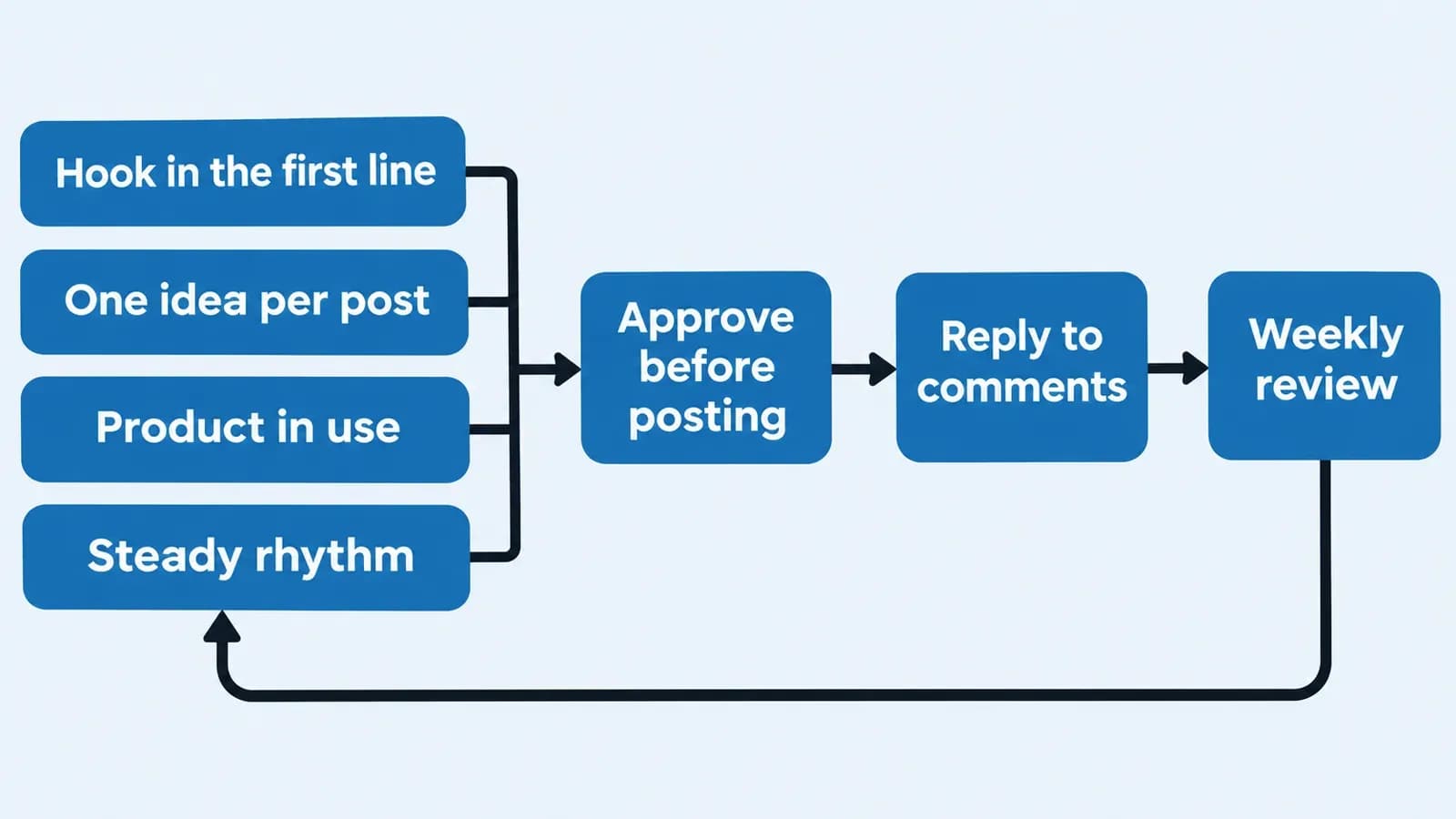
- Put the hook in the first line, and give each post one idea only.
- Show the product in use, not only on a clean backdrop.
- Pick a rhythm you can keep, reply to comments, and review your own analytics once a week.
- Draft ahead, then read and approve every post yourself before anything goes out.
To get more views on Instagram, work out why a post was passed over before changing anything. Check the first line, the number of ideas in the post, whether the product is shown in use, how steady the posting rhythm is, whether comments get replies and what your own analytics say. Then run one small routine each week. This article is for owners of small product brands who run the whole shop and need a method that fits into a few sessions, not a full-time job.
You will leave with a diagnosis table, a weekly routine, a hypothetical worked example and a short checklist. None of it is a promise of any result. It is a way to make each post clearer and to learn from your own account instead of guessing.
Diagnose first: why a post may get few views
A post with few views is rarely a verdict on the brand. More often one specific thing was unclear. Look at the post as a stranger would, scrolling quickly, and ask what that stranger saw first.
| What to check | A weak version | A stronger version |
|---|---|---|
| First line | Starts with greetings or background | Starts with the point, the question or the result for the reader |
| Idea | Covers a launch, a sale, a tip and a story at once | Covers one idea the reader can repeat back |
| Product | Only on a plain backdrop, with no context | Shown in use, in the setting where it belongs |
| Rhythm | Several posts in a burst, then silence | A schedule that fits your week and holds |
| Comments | Left sitting without a reply | Answered, with a question or detail added |
| Review | Checked only when worried | Looked at once a week, with notes |
This table is a diagnostic, not a ranking. Take one recent quiet post and go down the rows. The row that fits worst is where to begin.
A note on honesty: you cannot know from one post why it performed as it did. Treat each finding as a small test. Change one thing, post again and record what happened.
Put the hook in the first line
The first line is what a reader sees before deciding to read more. If it is a greeting, a date or a long lead-in, the useful part sits further down, where a quick scroller may never reach it.
Start with the thing the reader came for. A few shapes that work for product brands:
- The result: what the product helps someone do, in plain words.
- The question: the one customers ask in messages, phrased the way customers phrase it.
- The detail: a specific, true fact about how the item is made or used.
- The moment: the situation in which the product gets used.
Read the line out loud. If it would make sense on its own, with nothing else on screen, it is doing its job. If it only works after the second sentence, swap the order.
Keep the line honest. A hook that promises more than the post delivers may win a glance and lose trust. If your category has claim rules (beauty, food, supplements), keep the wording you already use on your product page.
One idea per post
A post that tries to say everything usually says nothing clearly. The cure is a simple rule: before drafting, write the idea in one short sentence. If the sentence needs the word "and" more than once, it is two posts.
Examples of one-idea sentences, for a hypothetical candle shop:
- This scent is made for slow evenings.
- Here is how a new batch gets poured.
- This is the question customers ask most about burn time.
Each one can carry a photo, a caption and a first line that all point the same way. Extra ideas go on a list and become next week's posts.
Show the product in use
A product on a plain backdrop tells the reader what it looks like. A product in use tells the reader what it is for. For a small brand, the second is usually the harder question to answer, and the more useful one.
Ways to show use without a studio:
- In a real setting: the candle lit on a windowsill, the sauce on a plate, the linen apron on a work table.
- In a step: the jar being opened, the label being peeled, the package being unwrapped.
- In scale: a hand holding the item, so the size is clear.
- In context: next to the things it is normally used with.
Keep the lighting simple and the frame uncluttered. If photos are your bottleneck, follow the home-shooting tips in the guide to ecommerce product photography at home.
Choose a rhythm you can keep
A steady rhythm matters more than an ambitious one. A schedule that collapses after two weeks leaves long gaps, and the gaps are harder to explain than a lighter schedule you actually hold.
Choose by looking at your week, not at what other accounts do. Decide how many posts you can make well, put those days in a calendar and treat the days as fixed. If a week gets crowded, skip a post on purpose instead of rushing a weak one.
Two practical supports:
- A simple calendar. A content calendar template in Google Sheets keeps the ideas list and the dates in one place.
- A posting time you can defend. There is no universal answer, so the guide to the best time to post for small brands explains how to test times for your own audience instead of trusting a rule.
Whatever rhythm you pick, write it down and review it at the end of the month. If it feels heavy, lower it. If it feels easy, you can add a post.
Reply to comments
Comments are the one place where a small brand can talk to readers directly. A reply that adds a detail or asks a question gives the reader a reason to answer again, and gives you real wording to reuse in later captions.
A routine that stays small:
- Reply to every genuine comment and question, in your own voice.
- Answer with something specific: a size, a scent note, a delivery detail.
- Save recurring questions in a notes file. Each one is a post idea.
- Stay inside your claim rules when a question touches health, ingredients or results.
For wording ideas when a comment is short or hard to answer, see Instagram comment ideas for small brands.
Review your own analytics once a week
Your own account shows what readers did with your posts. Open it once a week, at a fixed time, and keep the review small. The goal is to spot patterns across several posts, not to react to one.
Questions to ask each week:
- Which post did readers respond to most, and what was its first line?
- Which post was quiet, and which row in the diagnosis table fits it worst?
- Did a certain kind of photo, such as product in use, show up in the stronger posts?
- Which comments or messages suggested a question worth a post?
Write two lines in a notes file: what to repeat and what to change. Change one thing at a time, so the next review can show whether the change mattered. If the numbers look unclear, write that down too. A short record that admits uncertainty is more useful than a confident story.
The weekly routine, with approval first
Here is the whole routine in one pass. It is built around approval-first drafting: posts are drafted ahead and nothing goes out until you have read and approved it.
| Step | What you do | What it produces |
|---|---|---|
| 1. Review | Read last week's notes and your own analytics | Two lines: repeat and change |
| 2. Choose ideas | Pick one idea per planned post from your list | A short list of one-sentence ideas |
| 3. Draft | Write the first line and caption for each idea | Drafts, with the product shown in use |
| 4. Approve | Read each draft aloud, edit it, then approve it | Posts you stand behind |
| 5. Post | Publish on your fixed days | A steady rhythm |
| 6. Reply | Answer comments and save recurring questions | Replies and new ideas |
Drafting can be done by hand, from a notes file or with a tool. Youanai Social builds a Business DNA profile from your website, capturing brand voice and offer rules, and drafts social posts from it. Every draft waits for your approval, and you decide what is used. There is a free way to start.
Worked example (hypothetical)
This example is hypothetical, with an invented brand and invented posts, to show the method. It contains no real results and none are claimed.
Imagine a hypothetical one-person soap shop. The owner notices that recent posts seem to be passed over and goes down the diagnosis table with one quiet post. The first line began with a greeting, the caption covered a restock, a discount idea and a story about the studio, and the photo showed the soap on a white backdrop.
The owner makes three changes for the following week:
- The first line now opens with the point: a plain sentence about when the soap gets used.
- The post covers one idea only. The restock gets its own post, and the studio story goes onto the ideas list.
- The photo shows the soap beside a sink, in use, instead of on a blank backdrop.
On Sunday the owner drafts the week's posts, each with a one-sentence idea, then reads every draft aloud, trims it and approves it. Nothing is posted before that read-through. During the week the owner replies to each comment and saves a repeated question about scent as a post idea.
At the next weekly review the owner writes two lines. One notes that the in-use photo drew more comments about the scent, so the next posts will keep showing the soap in use. The other notes that the quiet post's replacement is too early to judge, so the same change stays in place another week. No claim is made that any one change caused any result. The notes simply decide what to try next.
FAQ
How do I get more views on Instagram as a small product brand?
Diagnose a quiet post first: check the opening line, the single idea, whether the product is shown in use, the posting rhythm, your replies and your own analytics. Then run one small routine each week and change one thing at a time. No method can promise a result.
Why are my Instagram posts getting so few views?
Often one specific thing is unclear: a weak first line, too many ideas, a product shown without context or an uneven rhythm. Go down the diagnosis table with one recent post, and treat each finding as a test instead of a verdict.
Does posting more often get more views?
Not by itself. A rhythm you can hold with posts you are happy with beats a burst you cannot keep up. Pick a schedule that fits your week and review it monthly.
How important is the first line of a caption?
It matters, because it is what a reader sees before deciding to read on. Open with the point, the question or the detail the reader came for, and keep it true to what the post delivers.
Should I reply to every comment?
Reply to every genuine comment and question where you can, with something specific. Replies give you wording and ideas for later posts.
How often should I check my analytics?
Once a week, at a fixed time, is enough for a small brand. Look for patterns across several posts and write two lines: what to repeat and what to change.
Can a tool help with the weekly routine?
A tool can help with drafting, but read and approve every draft before anything is posted. Youanai Social builds a Business DNA profile from your website and drafts social posts from it, and every draft waits for your approval before anything is posted.
Keep reading
Reel vs Story on Instagram: Which One a Small Shop Needs

Use a Story for a quick update, a Reel when there is a short moment worth showing and a feed post for…

9 min read
Instagram Post Ideas for a Small Product Brand, by Goal

Stop asking what to post and start asking what you are selling this week. Five idea types for a product brand, then…

10 min read
Best Hashtags for Instagram: A Small Set for Product Shops

The best hashtags for a one-person product shop are the ones that describe the post honestly. Build a small set in four…
10 min read