
Insights
How to Keep AI Social Posts in Your Brand's Voice
AI drafts go generic when the brief is blank. A one-hour setup, a refresh schedule and a refuse list give a small brand a profile to draft from, with the owner still approving each post.
Aayush Lamichhane
Founder & CEO
7 min read
In short
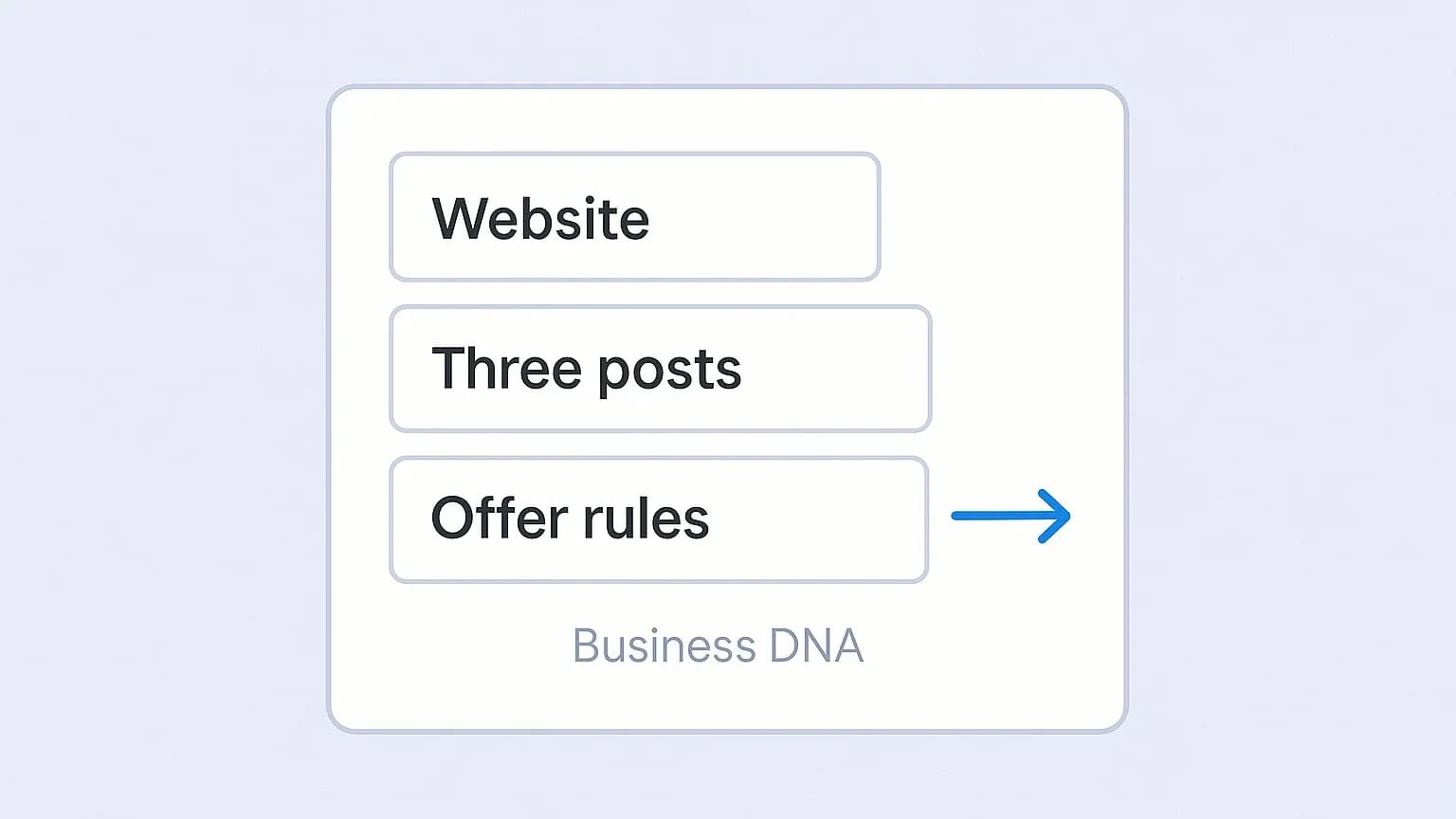
- Give the AI three inputs: your live website, three posts that sound like you, and a one-screen offer-rules card.
- Those inputs become a Business DNA profile, and every draft starts from it instead of a blank prompt.
- Smoke-test with one caption from a real product, and fix the profile rather than editing forever.
- Refresh the profile when prices, promos, claims or the site change, and at least monthly if you sell seasonally.
- Keep a refuse list for fake urgency, soft health claims and filler words.
- The profile improves the first draft. You still approve every post before it goes out.
A Business DNA profile keeps AI social posts on brand by giving the AI something to draft from. Build it from three inputs: your live website, three posts that already sound like you, and a one-screen card of offer rules. Drafts then start in your voice and within your facts, and you still approve each one before it goes out.
This is for owners of small, owner-run brands (skincare, specialty food, candles, makers) who are also the marketing team and don't have time to rewrite every caption.
Why a blank brief produces generic posts
When an AI tool has nothing to work from, it invents a confident voice. For a one-person brand, that usually means phrases like "thoughtfully crafted" or "elevate your ritual", and last month's launch price left in the draft pile.
Tools that turn a web page into content can help with volume. Fastlane's guide to turning a website into TikTok content describes getting many videos from one landing page's benefits, FAQs and proof points. That solves extraction. It does not decide which voice and which offers are allowed when the model fills the gaps, and that is the job of a profile.
If your calendar is empty, start with fixing the empty content calendar. If captions exist but read like a model wrote them, pair this page with how to fix captions that sound like AI.
The three inputs
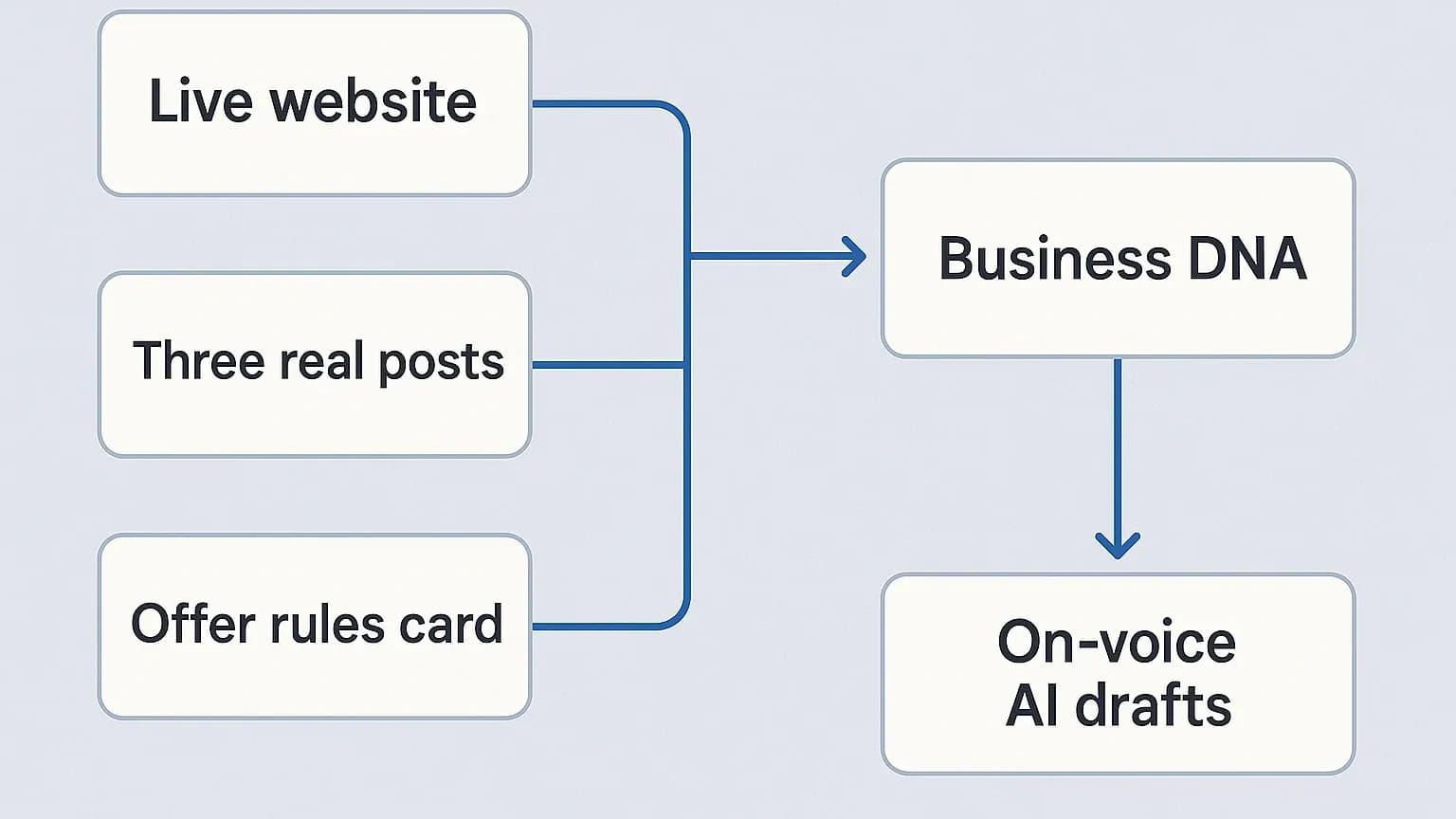
Website + 3 real posts + offer rules → Business DNA → drafts → you approve.
| Input | What it teaches the model | Done when |
|---|---|---|
| Live website (home page plus one or two product pages) | What you sell, who it's for, facts you already publish | The URL matches what customers can buy today |
| Three posts you would still publish | Sentence length, nouns, humor, what you never say | You would put your name under each one |
| Offer rules card | Price, stock, claims, promos you refuse | It fits on one screen |
In Youanai Social, the Business DNA profile is built from your website and acts as the base every draft starts from. Drafts wait for your approval and nothing is posted unsupervised, as the product's Social FAQ describes.
Setup checklist (about one focused hour)
Do this once, then revisit it on the schedule below.
- Pick sources. The home page plus one or two live product pages. Add the about page only if it sounds like you and not like a pitch deck.
- Pick three posts. Choose the most you, not the highest reach. One that teaches, one about process or making, and one about the shop or an offer make a solid set.
- Write the offer rules card. A plain note is fine. Include:
- the current hero product and its price band
- what you will never claim (medical claims, "cures", invented scarcity)
- promo wording allowed this month, or "no promo"
- words you refuse ("luxury", "disrupt", "elevate", category filler)
- Load the profile. Generate Business DNA from your website, and keep the rules card with your brand notes.
- Smoke-test. Ask for one caption and one hook from a real product. Reject anything that breaks the rules card. If a draft is wrong, fix the profile or the rules instead of editing every draft by hand.
- Keep the gate. Drafts go to review, you are the only approver, and only approved drafts get scheduled.
Things that weaken the result before you start: a thin homepage with no product facts, skipping the three posts because "the site is enough", last season's promo language still in the profile, and treating setup as a one-time checkbox.
Keep the profile current
A profile that is out of date drafts with old prices and old promos. Update it when something changes.
| Trigger | What you update | Time |
|---|---|---|
| New hero product or price change | Product page source and offer rules | 15 min |
| Promo week starts or ends | Promo wording and end date on the rules card | 10 min |
| You reject three drafts in a row for the same tell | Swap one of the three voice posts and add a refuse word | 20 min |
| Monthly (calendar reminder) | Refresh the profile sources if the site changed | 20 to 30 min |
| After a packaging or claim change | Facts on the product page and the refuse list | Before the next campaign |
What to refuse
Paste this under the rules card and edit the nouns for your category.
- Fake urgency ("only 3 left") when stock is fine
- Soft health or wellness claims you would not put on the product page
- Emoji walls and chains of synonyms for the same benefit
- Competitor trash-talk
- "As seen in..." for a mention you cannot name
- A voice that sounds like a pitch deck or a spa brochure you would never send a customer
When a draft is almost right, edit it like the owner you are, or tighten the profile and regenerate. Do not publish a draft that is only 90 percent right because you are tired. That is what the approve-to-ship check is for.
Worked example (hypothetical soap brand)
Hypothetical, not a customer story: a brand called "Harbor & Lye" sells cold-process citrus soap in 110 g bars. These are the inputs on hand.
| Input | What goes in |
|---|---|
| Website | Home page plus the page for Bergamot Dock Bar: ingredients, weight, "ships same day before 14:00", no medical claims |
| Three posts | (1) "Bergamot Dock Bar. 110 g. Olive oil + bergamot. Rinse, you're done." (2) A caption for a pour-and-cut process Reel in three short sentences. (3) "In stock. Link in bio. No 'limited drop' this week." |
| Offer rules | No "detox", no "cures eczema", no fake scarcity. Allowed: in stock, ships same day. Refused words: elevate, luxurious, artisanal journey. |
For contrast, here is a weak setup (also hypothetical): homepage only, three ads from a freelancer the brand stopped working with, and an empty rules card. The model fills the gaps with "spa-grade detox cleanse" and a discount code that expired in June.
With the fuller inputs above, each draft is checked against five gates:
| Gate | Pass means |
|---|---|
| Voice | Short nouns, no spa-brochure language, matches the three posts |
| Facts | 110 g, bergamot, olive oil, the same as the product page |
| Offer | In stock, ships same day before 14:00, no invented code |
| Claims | No detox, eczema or clinical wording |
| You | The owner would send it to a regular customer without cringing |
The same grid works for serum, sauce or jewelry. Swap the noun and the refuse words. Three honest posts plus a rules card do much of the work a long voice document would, and take far less time to write.
A Sunday check
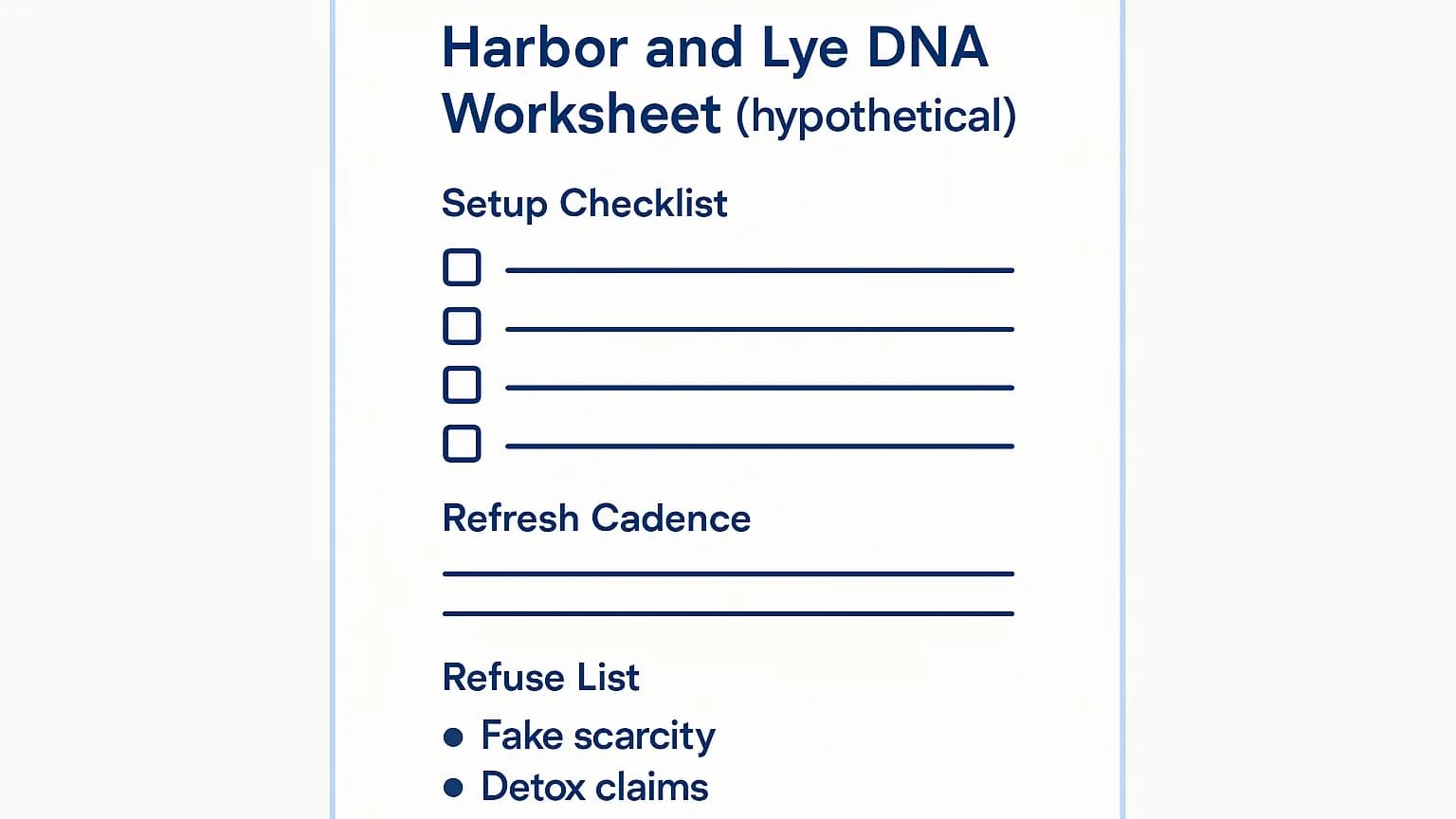
- Open the rules card. Are the price and promo still true?
- Skim the three voice posts. Would you still publish them?
- Generate or open the week's drafts.
- Run the approve-to-ship check. The week-from-product-page workflow shows one way to build the week.
- Schedule approved drafts only and park the rest. If the same problem repeats, update the profile before next Sunday.
FAQ
Is Business DNA just a brand kit with colors and a logo?
No. Colors and a logo help visuals. A Business DNA profile covers what you sell, how you sound and what you refuse, drawn from your website, real posts and offer rules. A logo pack without a refuse list still produces generic captions.
How is this different from pasting my URL into a content generator?
URL tools extract hooks and benefits from a page. A profile keeps your voice and offer rules across every draft, and a human approval still comes before posting. Extraction on its own does not tell the model what you refuse to say.
Do I need this if I write captions by hand?
Not for the writing itself, though a rules card helps anyone who writes for the brand. The profile starts to matter the day you want AI drafts and don't want to begin from a blank prompt.
How often should I refresh the profile?
Whenever the site, prices or promo rules change, and at least monthly if you sell seasonally. If you reject three drafts in a row for the same problem, update the voice posts or the refuse words that day.
What if my website is thin?
Fix the product page facts first: weight, ingredients, shipping and an honest FAQ. A thin site makes a thin profile. Do not invent social proof to fill the gap.
Does the profile replace my approval?
No. The profile improves the first draft, and you are still the gate before anything is posted. Pair it with the approve-to-ship workflow.
Which three posts should I choose?
Pick the ones that sound most like you, not the ones with the most reach. A set of one educational post, one about how you make the product and one about an offer covers the range.
Keep reading
Instagram Comment Ideas for Small Product Brands

Reply examples for the comments a small product brand actually gets, from ingredient questions to public complaints, plus honest ways to invite…

10 min read
Cottage Food Law Illinois: Selling and Promoting Online
Illinois allows in-state online sales and shipping of cottage food, with registration, a CFPM and a set label. Here is what the…
10 min read
Ecommerce Product Photography at Home: A Simple Setup

A phone, a window, a plain surface and a fixed shot list are enough to photograph a small catalogue consistently. Here is…

11 min read