
Social Workflows
Christmas Instagram Story Ideas for a Small Product Shop
A one-person shop does not need a big holiday campaign. Pick a few story types, spread them across the run-up to Christmas, and draft and approve the lot before any of it goes live.
Kushal Shrestha
Marketing & Engineering
10 min read

In short
- Use seven story types for the holiday run-up: gift picks, packing table, shipping dates, answers to questions, a gift note, a short countdown and a thank you.
- Split the run-up into phases (early browsing, gift decisions, last orders, after the rush) and give each phase its own job.
- Stories are quick and informal, so one clear point per frame is enough.
- Draft the whole run-up in a few sittings, then check each story against a short list before it goes out.
- Keep an approval step between the draft and the post so nothing goes live that you have not read.
The best Christmas Instagram story ideas for a one-person product shop are seven simple story types: gift picks, the packing table, shipping dates, answers to customer questions, a gift note, a short countdown and a thank you. Spread them across the weeks before Christmas, give each phase of the run-up one job, and draft and approve the stories before they go live. This article is for owners of small product brands who run the whole shop and want a holiday Stories routine that fits around packing orders.
You will leave with the seven types, a plan by phase, a checklist for each story and a hypothetical run-up to copy.
Why Stories suit the holiday run-up
Stories are short, informal and quick to make. That suits the weeks before Christmas, when the owner is also the packer, the customer service desk and the person answering the same shipping question again.
A feed post usually asks for a polished photo and a considered caption. A story can be a quick shot of a table, one line of text and a clear next step. You can show what is happening this week without producing something finished every time.
That also sets the standard for the holiday run-up: each story should do one small job. Help someone choose a gift, tell someone when to order by, or show that a real person is packing the box. If a story does none of these, skip it.
Seven Christmas story ideas for a product shop
Each of these uses material you already have: product photos, a packing table, questions in your inbox. None of them needs a studio or a script.
1. Gift picks
Show one product and say who it suits in plain words: "for someone who loves a quiet evening", "for a host who has everything", "a small gift under the tree". Name the product, the size or scent and where to find it. A short set of frames, one product each, works as a mini gift guide.
2. The packing table
Show the real work: a stack of boxes, a roll of tape, tags waiting to be tied, a tray of wrapped orders. Add one line of text about what is happening this week. The point is that a person runs the shop, which is a good reason for someone to buy from it.
3. Shipping dates
Holiday shoppers want to know when to order. Put your own last-order dates in a story, using the dates you have confirmed with your own carrier or delivery method, and repeat them as the date gets closer. This is the most useful story of the season, so do not leave it out because it feels dull to write.
4. Answers to customer questions
Your inbox holds the list: how long does it last, what is it made from, can it be gift wrapped, can a note go in the box. Answer one question per story, starting with the direct answer. A reader who has not asked yet gets the answer without needing to message you.
5. A gift note or wrapping detail
If you offer gift wrapping or a handwritten note, show it. A close-up of a wrapped box or a tag with the pen next to it tells a gift buyer what to expect. If you do not offer it, skip this type instead of inventing a service.
6. A short countdown
A countdown story only needs to say how long is left until a date that matters to the reader, such as the last day to order for your own delivery cut-off. Keep it factual. A countdown to something that has no real deadline reads as pressure, so tie it to a date you have actually confirmed.
7. A thank you
After the last orders ship, a short thank you with a photo of the empty packing table closes the run-up. If a customer has shared a photo or message and agreed that you may post it, it can go here. Ask first, and share only what the customer agreed to.
| Story type | What it does | Where the material comes from |
|---|---|---|
| Gift picks | Helps a buyer choose | Your product photos and page |
| Packing table | Shows the person and the process | Your packing area |
| Shipping dates | Answers when to order by | Your carrier information and calendar |
| Customer questions | Answers what buyers ask before buying | Your inbox and comments |
| Gift note or wrapping | Shows what a gift buyer receives | Your packaging |
| Short countdown | Marks a real date | Your own cut-off dates |
| Thank you | Closes the season | Your orders and permitted customer messages |
A run-up plan by phase
Instead of planning every day, plan four phases and give each one a job. A phase is a stretch of the run-up, and you choose where each begins and ends to match your own delivery dates.
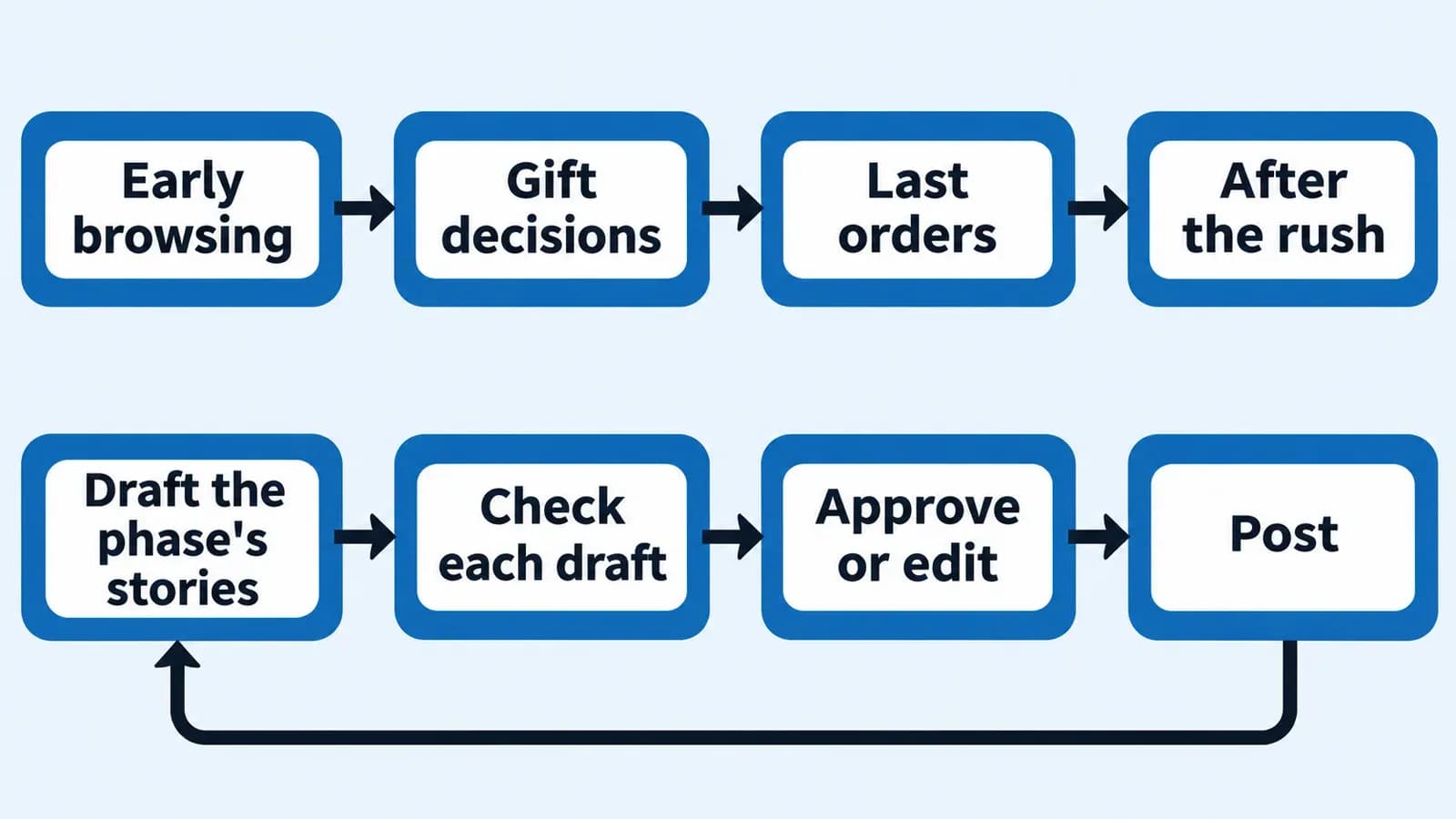
| Phase | Its job | Story types that fit |
|---|---|---|
| Early browsing | Let people see what you sell | Gift picks, packing table |
| Gift decisions | Help someone choose and feel sure | Gift picks, customer questions, gift note |
| Last orders | Tell people when to order by | Shipping dates, short countdown |
| After the rush | Close the season and say thanks | Thank you, packing table |
Inside each phase, pick a number of stories you can keep. A small routine you keep up is better than a grand plan that stops halfway. If you are not sure how often to post, how often a one-person beauty brand should post on Instagram covers choosing a rhythm you can maintain, and the reasoning carries over to a product shop.
Write the plan on one page as a list of phases and story types. That list is the plan. The stories come next.
Draft the run-up, then approve every story
Making stories one at a time, on the day, is what makes an account go quiet in the busiest week. Draft each phase in a single sitting instead, while you are in the same frame of mind, and the stories fit together.
A routine that works for a one-person shop:
- Pick the phase and its story types from your one-page plan.
- Gather the material. Photos, the customer question, your confirmed dates.
- Draft every story for the phase, even if rough.
- Check each draft against the list in the next section.
- Approve or edit. Nothing goes out until you have read it and agreed.
- Post, then note one thing to change in the next phase.
A draft can come from you, a notes file or a tool. Youanai Social builds a Business DNA profile from your website, capturing brand voice and offer rules, and drafts social posts from it. Every draft waits for your approval, and you decide what to use and where to post it. There is a free way to start.
If the photos are the sticking point, how to turn product photos into an Instagram week shows how to plan around the images you already have. If ideas run short, AI social media post ideas from what you sell shows how to turn each product into several. A repeatable approval step is what keeps a drafted run-up from going out with a mistake in it, and approve to ship for one-person ecommerce social shows one way to set that up.
Worked example (hypothetical)
This example is hypothetical, with an invented brand, to show the plan in action. It contains no real results and none are claimed.
Imagine a hypothetical one-person candle shop that ships its own orders. The owner decides on a number of stories a week that fits around packing.
Early browsing. The owner drafts a gift pick for one candle, with the scent notes, the size and who it suits. A second story shows the packing table with a stack of tags and a line saying new batches are being poured this week.
Gift decisions. A buyer has asked twice whether a candle can arrive with a handwritten note. The owner drafts a story that answers yes in the first line, then shows the tag and the pen. A customer question about how to trim the wick gets its own story.
Last orders. The owner checks the carrier's published dates, then drafts a shipping story with the confirmed last-order date. A short countdown story follows a few days later, using the same date.
After the rush. A thank you with a photo of the cleared packing table closes the season.
Review. For each phase, the owner reads the drafts against the checklist, cuts a sentence of hype from a gift pick and approves the set. At the end of each phase, one line goes in the notebook, such as which story was quickest to write.
Checks before a story goes out
Run every draft through the same short list before approving it:
- Does the first frame make the point? A reader tapping through should get it at once.
- Is the product named plainly? Name, size, scent or material, with no filler.
- Is there one clear next step? Visit the shop, read the details, send a message. One, not three.
- Are the dates right? Check every shipping date and cut-off against your own confirmed information before it goes out.
- Is every claim safe to make? No health, result or comparison claims you cannot back up. If a rule applies to your category (beauty, food, supplements), keep the wording you already use on your product page. If unsure, cut it.
- Does it sound like the shop? Read it aloud. If it sounds like an advert for someone else, rewrite it.
- Is a customer's name, photo or message used with permission?
Common mistakes
- Only showing products. A run of product shots is hard to care about. The seven types exist to prevent that.
- Leaving shipping dates until last. Gift buyers want them early and often.
- Making a countdown to a deadline that does not exist. Tie it to a real date.
- Planning more than you can write. Pick a count you can keep, then raise it only when the routine feels easy.
- Sharing customer content without asking. Always get a clear yes first.
- Posting without a read-through. Drafting ahead is safe only when approval sits between the draft and the post.
FAQ
What should a small shop post on Instagram Stories at Christmas?
Post gift picks, packing table moments, shipping dates, answers to customer questions, a gift note or wrapping detail, a short countdown and a thank you. Each one should help a buyer choose, trust the shop or know when to order.
How many Christmas stories should a one-person shop post?
Choose a count you can keep each week and treat a few stories as a place to start. A smaller routine you complete is better than a bigger plan that stops after a few days.
When should I start posting Christmas stories?
Start when you are ready to show gift ideas, and shape the plan around your own delivery dates. Work backwards from your last-order date and give each phase of the run-up its own job.
Should every story be about selling a product?
No. Mix product stories with the packing table, answers to questions and plain date notices. A page that only sells is harder to care about, and the other types help a buyer feel sure.
How do I avoid posting a wrong date or a claim I regret?
Draft ahead, then check each story against a short list and approve it before it goes out. Check every date against your own confirmed delivery information, and cut any claim you cannot back up.
Can AI write my Christmas Instagram stories?
A tool can draft story ideas and copy, but you should read and approve every draft before using it. Youanai Social builds a Business DNA profile from your website and drafts social posts from it, and every draft waits for your approval before anything is posted.
How long does it take to plan holiday stories?
Plan for one sitting per phase: pick the types, gather the photos and dates, draft, then review. The time varies by shop, so note how long the first phase takes and adjust the number of stories to match.
Keep reading
Best Hashtags for Instagram: A Small Set for Product Shops

The best hashtags for a one-person product shop are the ones that describe the post honestly. Build a small set in four…

10 min read
Skincare Product Photography at Home With Just a Phone

You can shoot skincare and beauty products at home with a phone, a window and a few household props. Here is the…

10 min read
What to Post on Facebook: A Weekly Mix for Small Brands

A one-person product shop does not need a big content plan for Facebook. Pick a few post types that suit the page,…
9 min read