
Insights
Cottage Food Law Wisconsin: Where You Can Sell and Promote
Home-canned foods in Wisconsin may not be sold online or out of state, and the state page on home-baked goods is silent on online sales. Here is what the official pages say and how to promote with cautious wording.
Kushal Shrestha
10 min read
In short
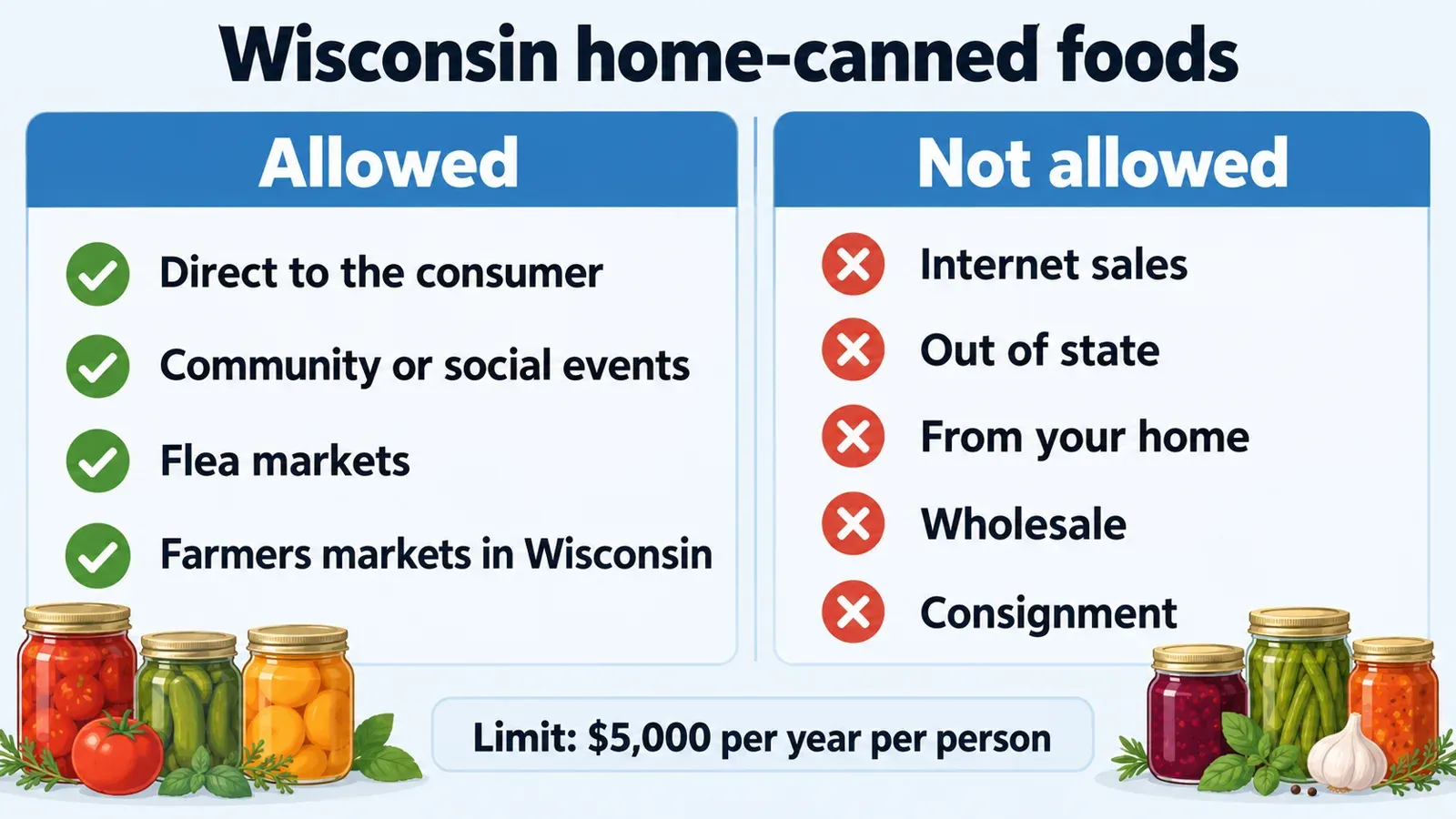
- Home-canned foods (the "Pickle Bill") may be sold only direct to the consumer at community or social events, flea markets or farmers markets in Wisconsin. Not online, not out of state.
- Home-canned foods need a label with the canner's name and address, the canning date, a fixed private-home statement and ingredients; a sign is needed at the point of sale.
- The state page on home-baked goods does not address online sales, shipping or labels. Get a written answer from DATCP before selling baked goods online.
- Event vendors need a Wisconsin seller's permit unless sales are exempt. Ask the Department of Revenue whether your foods are taxable.
- On Instagram, post market days, places and in-person pickup. Avoid posting "order online, we ship" for home-canned goods, and show the label statement in photos.
Under the DATCP home-canned foods page (the "Pickle Bill"), home-canned foods may be sold only direct to the consumer. The page allows sales at community or social events, flea markets or farmers markets in Wisconsin, and bans sales "via the internet or out of state". The state page on home-baked goods does not answer online or shipping questions, so ask DATCP in writing before selling baked goods online. This guide is for a small Wisconsin food maker who wants to sell and promote homemade food on Instagram without posting something the rules do not allow.
Not legal advice. This article summarises the official pages as read in October 2026. It is not legal advice, and rules and market details change. For questions about your own products, contact DATCP and get the answer in writing.
Home-canned and home-baked foods are treated differently
The two kinds of homemade food have very different pages on the state site, and the gap between them matters for what you post.
| Home-canned foods | Home-baked goods | |
|---|---|---|
| Official page | DATCP home-canned foods | DATCP home bakers |
| Sales cap | No more than $5,000 per year per person | Not stated on the page |
| Where to sell | Direct to the consumer at community or social events, flea markets or farmers markets in Wisconsin | Not stated on the page |
| Internet or out of state | Not allowed | Not addressed |
| Labels | Required content listed (see below) | Not addressed |
| Wholesale | Not allowed | "A business that is wholesaling baked goods must be licensed" |
The home-baker page is about court orders. It says they "apply only to people producing baked goods in their homes." It does not mention online sales, shipping, farmers markets, labelling or a sales cap. Silence on the page is not an answer either way. Until DATCP answers your specific question in writing, treat online sales and shipping of baked goods as unconfirmed.
What the home-canned rules allow
The DATCP page sets out the main limits.
- Products. Naturally acidic or acidified fruits and vegetables with a pH of 4.6 or lower. The page's examples include salsa, chutney, sauerkraut, kimchi, fruit jams and jellies, and applesauce. Refrigerator pickles are not covered.
- Cap. No more than $5,000 per year per person.
- Where. Direct to the consumer only, at community or social events, flea markets or farmers markets in Wisconsin.
- Not allowed. Selling via the internet or out of state, out of your home, wholesale, on consignment, or alongside licensed foods.
That last point shapes a stall layout. The page lists selling alongside licensed foods as not allowed; ask DATCP how that applies to a shared booth.
Labels and the point-of-sale sign
Every home-canned jar needs a label with these items, according to the DATCP page:
- The name and address of the person who did the canning.
- The date of canning.
- The statement: "This product was made in a private home not subject to state licensing or inspection."
- Ingredients in descending order, with allergens named by their common name.
At the point of sale, a sign must read: "These canned goods are homemade and not subject to state inspection."
For home-baked goods, the home-baker page does not list label rules. Ask DATCP what a baked-goods label must carry before printing any.
The seller's permit and sales tax
Selling at an event usually means a Wisconsin seller's permit. The Department of Revenue page on temporary events says vendors at Wisconsin events "must have a Wisconsin seller's permit unless the vendor's sales are exempt from sales or use tax." The exceptions it names are selling only nontaxable items, the occasional sale exemption, or display only.
Other points from that page:
- The permit should be displayed at events.
- Event operators report vendors on Form S-240.
- A vendor may include tax in prices if "Prices Include Sales Tax" is posted.
- Out-of-state exhibitors selling onsite need a permit once taxable sales reach $2,000 in a calendar year.
The page does not say whether cottage foods are taxable. Ask the Department of Revenue before the first market day, and again if the product line changes.
Markets: who takes cottage foods and crafts
Each market sets its own rules on top of the state's. The table shows what four organiser pages say for 2026. Confirm with the organiser before applying, because pages change each season.
| Market | 2026 season shown | What the page says about vendors |
|---|---|---|
| Dane County Farmers' Market, Saturday on the Square (Madison) | April 11 to November 14, 6:15 am to 1:45 pm | Producer-only. "Allows only Wisconsin agriculturally related items that vendors actively produce. Craft-type items are not allowed." Entry is by waiting list with a $25 application fee. |
| Oshkosh Farmers Market | Saturdays, May 30 to October 31 (except July 4), 8 am to 12:30 pm | "Items sold at the market must be grown, raised or handmade by the vendor." Agriculture vendors get priority. A $300,000 liability insurance certificate is required. Applications were requested by email after March 1, 2026. |
| Janesville Farmers Market | Saturdays, May through October, 8 am to 1 pm | Welcomes "skilled handcrafts" and prepared or preserved foods. Fees are not published. |
| Farmers Market on Broadway (Green Bay) | Wednesdays, May 20 to September 30, 3 pm to 8 pm | Applications go through MarketSpread. Check the organiser on which products are accepted. |
Two takeaways. A producer-only market that bars craft-type items is a different fit from one that welcomes handcrafts and preserved foods, so a maker who sells both jam and candles may need two kinds of markets. And the season matters: most of these markets run roughly May to October, so a post in January about a market day will confuse readers.
Weather also shapes the calendar. Madison's average high is above 80°F only in July (82.1°F), and lows fall below 32°F from November through March, per Madison climate normals for 1991 to 2020. Milwaukee has highs above 80°F in July (81.9°F) and August (80.3°F) and lows below 32°F from December to March. Cold mornings and warm afternoons are worth planning around for an outdoor stall.
How to promote within the rules on Instagram
The official pages do not address advertising or social posts. The points below are cautious practice, not DATCP guidance.
The rules above turn into a short posting policy.
For home-canned goods
- Avoid posting "order online, we ship." The page bans sales via the internet or out of state, and a post that invites online orders points the wrong way.
- Post market days, the market's name, the town and the hours instead. Use the organiser's published hours, not remembered ones.
- Offer in-person pickup only where the pickup is a sale at a permitted venue. Whether any pickup arrangement fits the "direct to the consumer" limit is a question for DATCP; the page lists events, flea markets and farmers markets.
- Avoid saying "DM to order" or adding a payment link in the bio for canned goods.
- Show the label in photos, including the statement "This product was made in a private home not subject to state licensing or inspection," so followers see the same wording that is on the jar.
- Include the point-of-sale sign in a stall photo: "These canned goods are homemade and not subject to state inspection."
- Avoid stating a health benefit or a food-safety result. Stick to what the product is, the flavour and the maker's name.
For home-baked goods
- Until DATCP answers in writing, avoid "we ship" and "order online" for baked goods too.
- Wholesale is not something to hint at in a post: the page says a business wholesaling baked goods must be licensed.
For both
- Say which days and which market, and say when the season ends.
- Keep the seller's permit visible at the stall if one applies, and mention in the caption that prices include tax only if the sign says so.
A worked example (hypothetical)
A hypothetical maker sells salsa and applesauce at two Saturday markets and keeps a small website with a product list. This is invented to show the method, not a real business or result.
- Start from the website. The maker lets Youanai Social read the site to build a Business DNA profile: brand voice and offer rules. Before drafting, the maker adds a plain offer rule to the profile: "Home-canned goods are sold in person at Wisconsin markets only. Avoid mentioning shipping or online orders."
- Draft the week. Three drafts are generated from the product list: caption text for a salsa jar photo the maker takes, a stall photo with the point-of-sale sign, and a "this Saturday" market-day post with the name and hours copied from the organiser page.
- Approve each draft. Every draft waits for the maker's approval before anything is posted. The maker checks each for "ship," "order online," "DM to order" and health claims, and rewrites any line that breaks the rule.
- Re-check each season. The maker rereads the DATCP page and the market page once a season, and updates the Business DNA if either changes.
The product does not know the law. The owner supplies the rule and reviews each draft, which is why approval before posting matters here. For more on that step, see how a one-person brand approves posts before they ship. For a food-specific content rhythm, see the specialty food restock week for Instagram.
Before you post: a short checklist
- Which category is each product: home-canned or home-baked?
- For canned goods, is each post about an in-person sale at a permitted venue?
- Does the label carry all four required items, and does the photo show the statement?
- Is the sign at the stall?
- Do you have a seller's permit, or a written reason you are exempt?
- Have you asked DATCP, in writing, about anything the pages do not cover?
To build a steady weekly rhythm around those posts, the guide to post ideas drawn from what you sell and the piece on Business DNA for a one-person brand go deeper on the method.
FAQ
Can I sell home-canned food online in Wisconsin?
No. The DATCP page for home-canned foods says sales must be direct to the consumer at community or social events, flea markets or farmers markets in Wisconsin, and it bars selling "via the internet or out of state." Check the DATCP page for current wording.
Can I sell home-baked goods online in Wisconsin?
The state's home-baker page does not say. It covers court orders about home bakers and does not address online sales, shipping, markets, labels or a sales cap. Get a written answer from DATCP before selling baked goods online.
How much can I sell of home-canned foods?
The DATCP page sets the cap at no more than $5,000 per year per person. That cap is stated for home-canned foods; it is not stated for home-baked goods.
What must a home-canned food label include?
The name and address of the person who did the canning, the date of canning, the statement "This product was made in a private home not subject to state licensing or inspection," and ingredients in descending order with allergens named by common name. A sign at the point of sale must say the goods are homemade and not subject to state inspection.
Do I need a seller's permit to sell at a farmers market?
Event vendors must, unless exempt, per the Department of Revenue's temporary-events page; ask DOR whether your market counts. One named exemption is selling only nontaxable items. Whether cottage foods are taxable is not stated on that page, so ask the Department of Revenue.
Can I post my products on Instagram if I cannot ship them?
The pages read here do not address social posts. Because home-canned foods may not be sold via the internet, avoid posts that invite online orders, and ask DATCP if unsure.
Do all Wisconsin farmers markets accept cottage foods and crafts?
No. Dane County's Saturday on the Square allows only Wisconsin agriculturally related items that vendors actively produce and does not allow craft-type items, while Janesville's page welcomes skilled handcrafts and prepared or preserved foods. Read each market's vendor page and ask the organiser.