
Insights
Before You Launch: A Skincare Content Checklist for a One-Person Brand
A launch-week checklist for a solo skincare founder: settle product facts, check claims, prepare answers, then approve three posts before anything ships.
Youanai Editorial
5 min read
Launch week for a solo skincare founder is not a marketing season. It is five spare minutes between packing tape and order confirmations. The captions that fail are rarely lazy. They are unready: the price changed, the ingredient list moved, the shipping window slipped, or a claim wandered into drug territory.
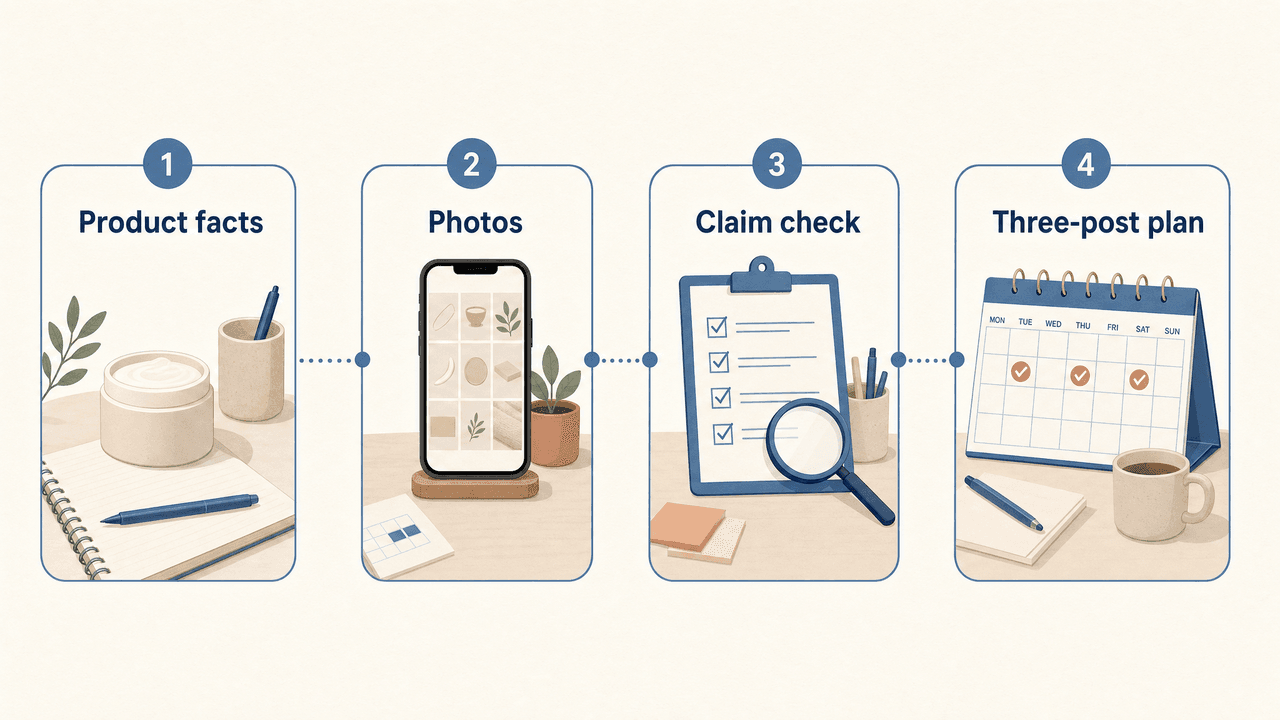
So treat launch content like you treat a label. Check it before it ships. This is a checklist a one-person brand can finish in one sitting: settle the product facts, check the claim language, prepare buyer answers, and approve a three-post plan before anything goes live.
This is not a repeat of the weekly plan for one skincare product. That piece covers an ordinary week. This one covers launch readiness: the facts, approvals, and answers that keep launch posts from embarrassing you or the brand.
What "ready" actually means
Launch content is ready when four things are settled, not when you feel excited:
| Readiness | It is done when |
|---|---|
| Product facts | Name, size, price, ingredients, and how-to-use match the product page and label |
| Photos | Three usable shots exist: clear product, texture or process, and one real-life context |
| Claim check | Every sentence matches what a cosmetic may say, with no treatment or cure language |
| Buyer answers | Shipping window, returns, stock reality, and use instructions are written down where buyers ask |
If one row is empty, the launch can wait. A late post beats a wrong post.
The facts that hold every caption together
Write these five facts on one card before you write one caption:
- Exact product name and size
- Price on the live product page
- Ingredient list as shown on the label
- How to use it, in the label's own words
- Real shipping window for the next seven days
Every caption comes from that card. If a fact changes, you fix the card once, not every post. This is the same one-SKU discipline as filling an empty content calendar: write from what you can actually ship this week.
Where claim language burns small brands
The FDA draws the line by intended use, and your captions count as claims. A moisturizer is a cosmetic when it is meant to cleanse, beautify, or alter appearance. The same jar becomes a drug if it is promoted to treat, prevent, or cure a condition, or to affect the structure or function of the body. A claim in a caption can establish that intended use, and "cosmeceutical" is not a legal category that gets you out of it (FDA, "Is It a Cosmetic, a Drug, or Both?").
Practical rule for a one-person brand: if the sentence could be said about a medicine, do not post it. "Cuts the look of dullness" stays closer to appearance. "Heals eczema" does not. When a condition name appears in the sentence, stop and get qualified review before posting. This article is not legal advice for your specific product; it is a discipline for writing captions that stay on the cosmetic side of the line.
Photos: three jobs, no studio
You need three shots, not a campaign:
| Shot | Job | What good looks like |
|---|---|---|
| Product | Identification | Clean light, true color, readable label |
| Texture or process | Proof of craft | Swatch, pour, batch, or fill shot from your real work |
| Context | Believability | The product where it is actually used, honestly staged |
TikTok's beauty creative guidance makes the same point in ad language: specific, native, and honest beats polished and interchangeable (TikTok Creative Center). A phone shot of the real balm beats a stock photo of someone else's cream.
A three-post launch sequence
| Day | Post | Job |
|---|---|---|
| Tease | Process shot, no price yet | Let people see the real work behind the launch |
| Launch | Product shot + one fact + where to buy | Make the ask clear and link the product page |
| Follow-up | Answer the top buyer question | Handle shipping, size, or use with the honesty buyers expect |
That is the whole launch. Stories and extra posts are optional. Do not build a countdown machine you cannot maintain.
Hypothetical (not a customer story): let's say you are launching a 2 oz oat balm alone. Facts card: oat balm, 2 oz, $18, shipping Tuesday and Friday, use on dry elbows and cuticles. Tease: pouring the batch with a plain caption, "Friday. Small batch." Launch: clean jar shot, "2 oz oat balm, $18, ships Tue/Fri," link in bio. Follow-up: "Since we got asked: 2 oz is roughly a pocket-size jar, and it ships twice a week." No cure claims, no countdown spam, no invented demand.
What not to schedule
- "Cures," "heals," or "treats" followed by a condition name
- Before-and-after photos as proof, unless your claims and documentation can carry them
- Countdowns for a launch date you may miss while packing
- "Only 3 left" when the shelf is full
- A giveaway that requires buyers to tag three friends before launch day
Urgency you invent this week costs trust you need next quarter.
Approve before anything ships
Solo does not mean skip review. Read each caption as a stranger who screenshots carelessly. Check names, prices, links, and the claim line. Then approve.
Owner-run shops that need drafts waiting for a yes instead of a blank screen fit the ecommerce brands lane we build for. If you want AI-drafted launch captions that stay on your facts and wait for your approval, start from an empty calendar in Youanai Social. You make the call before anything ships.
FAQ
How far ahead should I prepare launch content?
Prepare the facts card as soon as the label is final, and draft the three posts one week before launch. That leaves room for a shipping date or stock change without a scramble.
Can I launch with phone photos?
Yes. Use clean light, true colors, and the three jobs: product, texture or process, and context. Buyers trust a real phone shot of the actual product over a polished photo of someone else's.
What skincare claims are safe in captions?
Stay with appearance and sensory language the label supports. Avoid treating, healing, or preventing a condition. The FDA treats claims as evidence of intended use, so a caption can change what your product is legally considered to be. Get qualified review for anything borderline.